
Part of our guide Test Before You Build, which puts every article on this topic in the order you will need them.
Key takeaways
- Testing demand means watching what strangers do, not asking what they think. Actions that cost people something, like an email address or a deposit, are stronger evidence than likes or compliments.
- You can run most tests before a physical product exists, using renderings, a simple website, and tracking that shows where visitors come from and what they do.
- Decide what result would count as success before you start, and change one thing at a time, or the numbers will be hard to read.
- Every test can mislead. Small samples, holiday timing and friendly audiences all inflate results, so treat a test as evidence for a decision, not a guarantee.
One of the most expensive mistakes an inventor can make is ordering inventory for a product nobody buys. Tooling, minimum order quantities and shipping are paid up front, and they are very hard to undo.
Testing demand first flips that order. You spend a small, capped amount to learn whether strangers want the product, which people want it most, and what they will pay. Then you decide whether to manufacture, license, change the product or stop.
This guide covers what counts as real evidence, the main ways to test, how to test price, what results to expect, and where tests go wrong. Each section links to a deeper article if you want more detail.
Why test demand before you manufacture?
Because a working product is not the same as a wanted product. In CB Insights’ 2026 analysis of venture-backed startups that shut down since 2023, 43% of those with identifiable failure reasons cited poor product-market fit, meaning the product did not match what enough customers wanted. Those were funded startups, not solo inventors, but the lesson carries over: a lack of demand often shows up only after the money is spent.
For inventors, the timing makes it worse. Costs are moving targets in 2026, as our article on testing before you build in a year of tariff changes explains. Demand is the half of the equation you can measure now, cheaply, before you commit.
What counts as evidence of demand?
Not all signals are equal. A useful way to think about them is a ladder: the more an action costs the person taking it, the more it tells you.
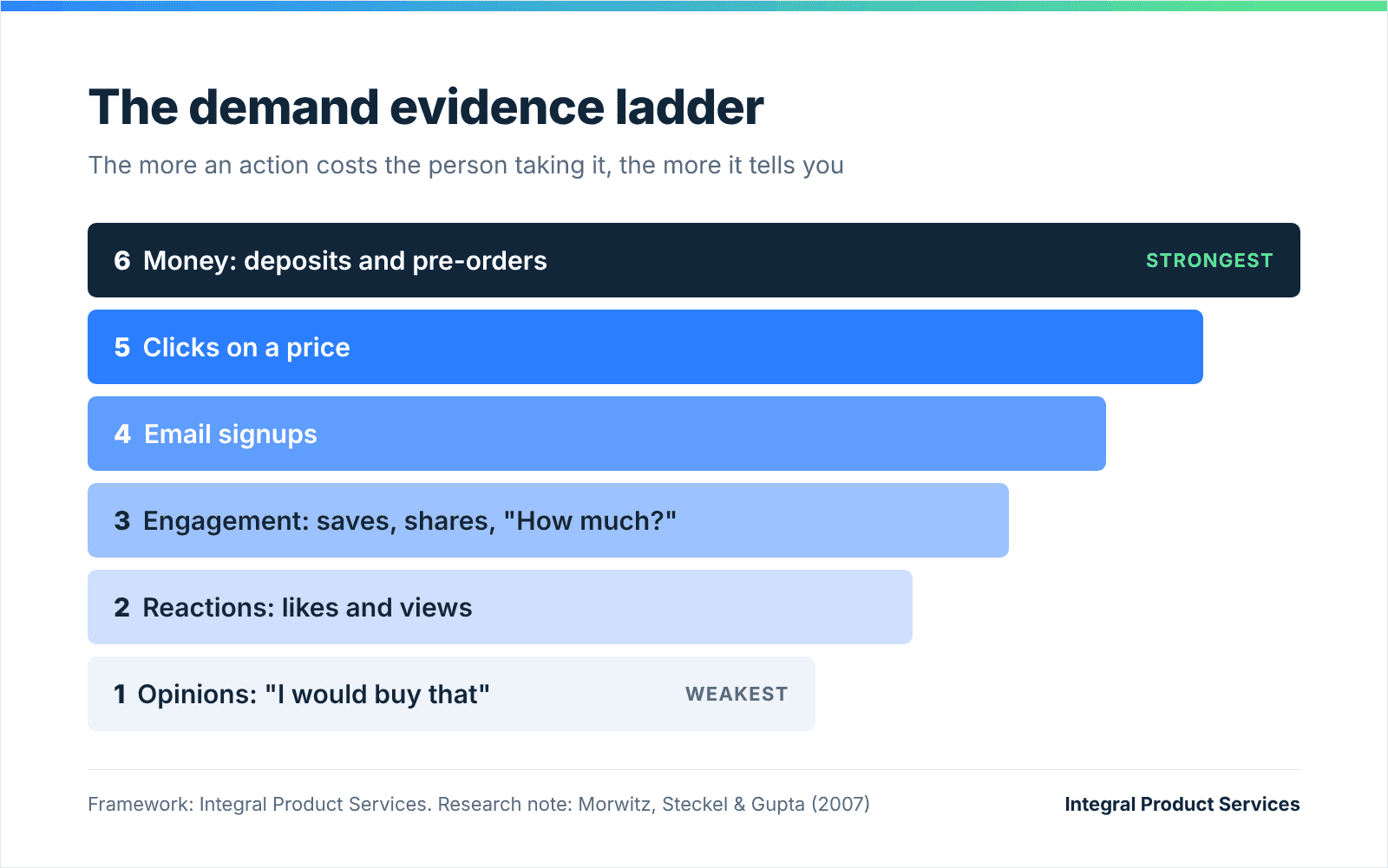
Free to use with credit: you may share this graphic as long as you link back to this article.
- Opinions: “I would buy that.” Friendly, but weak.
- Reactions: likes and views. They cost nothing.
- Engagement: saves, shares, tags and questions like “How much?” or “Where can I get it?”
- Email signups: a stranger gives you a way to reach them.
- Clicks on a price: someone sees what it costs and still wants to continue.
- Money: a deposit or a pre-order.
Research on purchase intentions backs this up. A study by Vicki Morwitz, Joel Steckel and Alok Gupta in the International Journal of Forecasting found that stated intentions predict actual purchases less well for new products than for existing ones, and less well over long time horizons. A new invention that will not ship for months is exactly that case. So treat “I’d buy it” as a starting point, and look for actions higher up the ladder.
What do you need before you run a test?
A demand test is only as good as what people see and what you can measure. Before you start, have:
- Clear visuals. Photorealistic renderings or prototype photos, and ideally a short video showing the problem and your solution. Our guide on patenting without a prototype explains why renderings are often enough at this stage.
- A simple web page. One product, one clear benefit, a price or price range, and one action: join the list, or place a pre-order.
- Tracking. Analytics that show where visitors came from and what they did, so you can tell a strong channel from a weak one.
- A written decision rule. Before you spend anything, write down what result would mean go, change or stop. Deciding afterward invites wishful thinking.
- A budget cap. A fixed amount you are prepared to spend to learn the answer.
Six ways to test demand, from cheapest to strongest
Each method asks for a little more money or commitment than the one before.
- Problem conversations. Talk with people who have the problem your invention solves. Ask how they deal with it today and what they have already tried, rather than whether they would buy your product. This shapes your message, but it is opinion-level evidence.
- Organic social content. Posting about the problem and your solution costs time rather than ad spend. Saves, shares and questions are the signals to watch, as our article on organic social as a market test explains.
- A waitlist page. A landing page that asks visitors to join a list for launch news. For reference, Unbounce’s 2024 benchmark report puts the median conversion rate across the landing pages it analyzed at 6.6%, across all industries. A brand-new product with no existing audience may land below that.
- A small paid ad test. Ads let you reach strangers on purpose and compare messages, audiences and prices. Our article on rising ad costs covers the math. Keep in mind that ad platforms need volume to settle: Google’s guidance for its Demand Gen campaigns suggests allowing around 50 conversion events before making bidding changes, so a very small test can swing a lot.
- Pre-orders. Taking real orders before the product ships is the strongest common signal short of sales, and it comes with rules. Under the FTC’s Mail, Internet, or Telephone Order Merchandise Rule, you need a reasonable basis for any shipping time you state; if you state none, you need a reasonable basis to believe you can ship within 30 days; and if you can’t ship on time, you must ask buyers to agree to the delay or let them cancel for a full, prompt refund. Our article on pre-orders as market research covers what the numbers can and cannot tell you.
- Crowdfunding. A public campaign on a platform like Kickstarter tests demand and raises money at the same time, but it commits you to delivering and puts your idea in public view. Kickstarter no longer publishes live success-rate statistics, so be wary of anyone quoting a precise figure.
A note on “fake door” tests, where a page shows a product and a buy button before the product exists: if you collect any payment, the FTC’s rules apply. FTC staff guidance on testing a product that is not yet available is narrow, and its conditions include making no suggestion that the merchandise will be shipped, disclosing that it is only planned and may not ship, and, if you decide not to ship it, letting buyers cancel and promptly refunding anyone who paid. Many inventors simply stop at the email signup step instead.
How do you test price?
Price is often the most valuable thing a test can tell you, and the hardest to get right.
Surveys are a starting point. A common method, the Van Westendorp price sensitivity meter, asks four questions: at what price the product would seem so cheap you would question its quality, a bargain, expensive, and too expensive. Survey firm Qualtrics notes that direct price questions tend to produce answers below what people would actually pay, so treat survey results as a range to test, not an answer.
Real behavior is better. Show the price on your page and watch how many visitors still click to continue. You can test two prices by running them one after the other with the same audience and the same ad, so the only thing that changes is the price. Expect higher prices to convert fewer visitors; the question is whether the revenue per visitor holds up. Use your landed cost to check that the price you test leaves a real margin.
What results count as good?
There is no universal pass mark, which is why the written decision rule matters. Two published benchmarks give rough context, as long as you do not compare them to each other, since they measure different things:
- Landing page conversions: Unbounce’s 6.6% median, across all industries in its 2024 report.
- Store purchases: DTC Pages found a median ecommerce conversion rate of 2.07% across 21 active, well-managed Shopify stores from its own portfolio (second quarter of 2026). A product nobody has heard of may start lower.
Here is an illustration with round numbers, not a forecast. Say a small ad test sends 1,000 visitors to a waitlist page and 4% sign up. That is 40 people who want to hear more, which is encouraging but not proof. If you then show a different 500 visitors a page with a price and 10 click to continue, you have learned something about price that no survey could tell you. Then read the data the way you would read your first 90 days: by source, by message, and over time.
How long should a test run, and what will it cost?
Long enough to smooth out day-to-day noise, and short enough to keep the budget under control. For many products that means two to six weeks per test, with one variable changed at a time.
Cost depends almost entirely on whether you pay for traffic. Organic content and problem conversations cost time. Paid tests cost whatever you cap them at. Using round numbers again: at $1 per click, 1,000 visitors costs about $1,000; at $2 per click, twice that. Set the cap before you start, and stop when you reach it.
Timing matters too. A test during the holidays competes with deep discounts and crowded ad auctions, which is why we explain in our holiday article that the season is often better for preparing a test than running one.
Where do demand tests mislead?
Every method has blind spots, and knowing them is part of reading the result honestly:
- Friendly audiences. Family, friends and your own followers are kinder than strangers. Count them separately.
- Small numbers. A handful of signups can swing either way by chance. Look for a pattern, not a single good week.
- Novelty clicks. An eye-catching video can earn clicks from people who were never going to buy.
- Timing. Seasonal events can inflate or depress results that would look different in an ordinary month.
- Gift versus everyday buyers. People buying for someone else may not represent your long-term customer.
- Platform effects. Ad algorithms optimize toward cheap actions, which may not be the buyers you want.
None of this makes testing pointless. It means a test is evidence for a decision, not a guarantee of sales, and the most reliable signal is a pattern that holds across several weeks, messages and audiences.
What should you do with the results?
Most results fall into one of three groups:
- Strong and consistent: people sign up, click through on price, and some pay. You have a case for manufacturing, or for licensing to a company that already sells to these buyers. Our License It or Build It? framework and our guide to licensing an invention cover both roads.
- Mixed: interest is real but uneven. Change one thing, the message, the audience or the price, and test again.
- Weak across fair tests: if several honest tests at different prices show little interest, stopping or rethinking the product can be the sound financial decision. That is the test doing its job.
Doing this well draws on several specialties at once: renderings and video, a website, ad and social campaigns, and analytics. Coordinating them is its own job, which is why many inventors bring in help for parts of it.
Questions inventors ask about testing demand
Do I need a prototype before I test demand?
Usually not. For many consumer products, photorealistic renderings and a short video are enough to test interest and price. A working prototype matters more when the value depends on a mechanism people need to see in action.
Is it legal to take pre-orders before the product exists?
Generally yes, but a pre-order is a promise to ship. Follow the FTC’s Mail, Internet, or Telephone Order Merchandise Rule: have a reasonable basis for the shipping time you state, notify buyers of delays, and offer refunds when required.
How many signups is enough?
There is no magic number. What matters is whether the result clears the decision rule you wrote before the test, and whether it holds up across several weeks and messages. A few dozen engaged strangers is more meaningful than hundreds of likes.
Could someone copy my idea if I test it in public?
It is possible, which is why it is wise to file a patent application before you show the invention publicly. A granted patent gives you rights to enforce, though it is not proof that anyone will buy.
Ready to test your invention?
At Integral Product Services, we help inventors test the market before they spend on inventory, with renderings, a website that can take pre-orders and collect emails, social campaigns and the analytics to read the results. If you hold a patent or a pending application, you can request a free, no-obligation Patent Review or call us at 813-413-1863.
Not ready for a call? The same page offers our free guide, After You File.
This article is general information, not legal, financial or advertising advice. Benchmarks and illustrations are not forecasts for any specific product. Talk to a qualified professional about the rules that apply to your sales and advertising.
Sources
- CB Insights, The top reasons startups fail, March 5, 2026
- Morwitz, Steckel and Gupta, When do purchase intentions predict sales?, International Journal of Forecasting, 2007
- Unbounce, Conversion Benchmark Report 2024
- DTC Pages, Ecommerce Conversion Rate Benchmarks 2026
- Google Ads Help, Create a Demand Gen campaign
- FTC, Business Guide to the FTC’s Mail, Internet, or Telephone Order Merchandise Rule
- Kickstarter, Stats page (now redirects to the 2025 Year in Review) and A Year in Review: 2025 Kickstarter Highlights
- Qualtrics, Van Westendorp pricing studies explained
Have a patent or patent pending? Let’s find your next step.
Get a free Patent Review from a Product Launch Specialist. No cost, no obligation, prototype not required.