Part of our guide Test Before You Build, which puts every article on this topic in the order you will need them.
Key takeaways
- The holiday season brings a surge of online shoppers, but also the deepest discounts and the most crowded ad auctions, which makes it a noisy time to test a brand-new product.
- A full-price product tested during Cyber Week competes with discounts that Adobe expects to reach up to 30% off, so weak results may reflect the timing rather than a lack of interest.
- The holiday months are well suited to building test assets and collecting emails, while a paid market test is often easier to read after the holidays.
- If your product is a natural gift, the season can tell you something useful, as long as you remember that a gift-season result may not repeat in March.
If your patent is granted or pending and you have been waiting for the right moment, the calendar may seem to be making the decision for you. Shoppers are expected to spend more online than in any holiday season before. It is natural to think: if we are ever going to put this product in front of people, now is the time.
The forecasts support the excitement. Adobe expects US shoppers to spend a record $275.1 billion online between November 1 and December 31, up 6.7% from last year. Deloitte’s forecast, which covers November through January, expects e-commerce sales to grow 7.5% to 8.4%.
But more shoppers is not the same as a better test. For a product nobody has heard of yet, the holidays bring real opportunities and some specific traps. Here is how we think about it.
What is the goal of your first market test?
Before choosing a date, be clear on what you need to learn. For most first-time inventors, the first test is not about revenue. It answers three questions: do strangers care, which people care most, and what price will they pay.
A test is only useful if you can read the results. A season that brings more shoppers but also more noise can produce numbers that look exciting or disappointing for reasons that have little to do with your product. We wrote about separating signal from noise in Reading Your First 90 Days of Data.
Why are the holidays a noisy time to test a new product?
Three things change at once in November and December.
- Discounts set price expectations. Adobe expects discounts of up to 14% in early November, up to 21% just before Thanksgiving, up to 30% during Cyber Week (Thanksgiving through Cyber Monday), and up to 10% to 15% through December. A new product offered at full price may be compared with all of it.
- Ad auctions get crowded. Online ads are sold in auctions, where advertisers bid for the chance to show an ad to a given audience. Around Black Friday, large retailers bid heavily for the same shoppers, and the price of ad space tends to rise. A small test budget buys fewer views. We covered why that matters in Cheap Traffic Is Gone.
- Many shoppers are cautious. In its 2026 holiday predictions, Salesforce says 35% of holiday shoppers are trading down to cheaper alternatives. A new, unknown product asks for more trust than a familiar brand on sale.
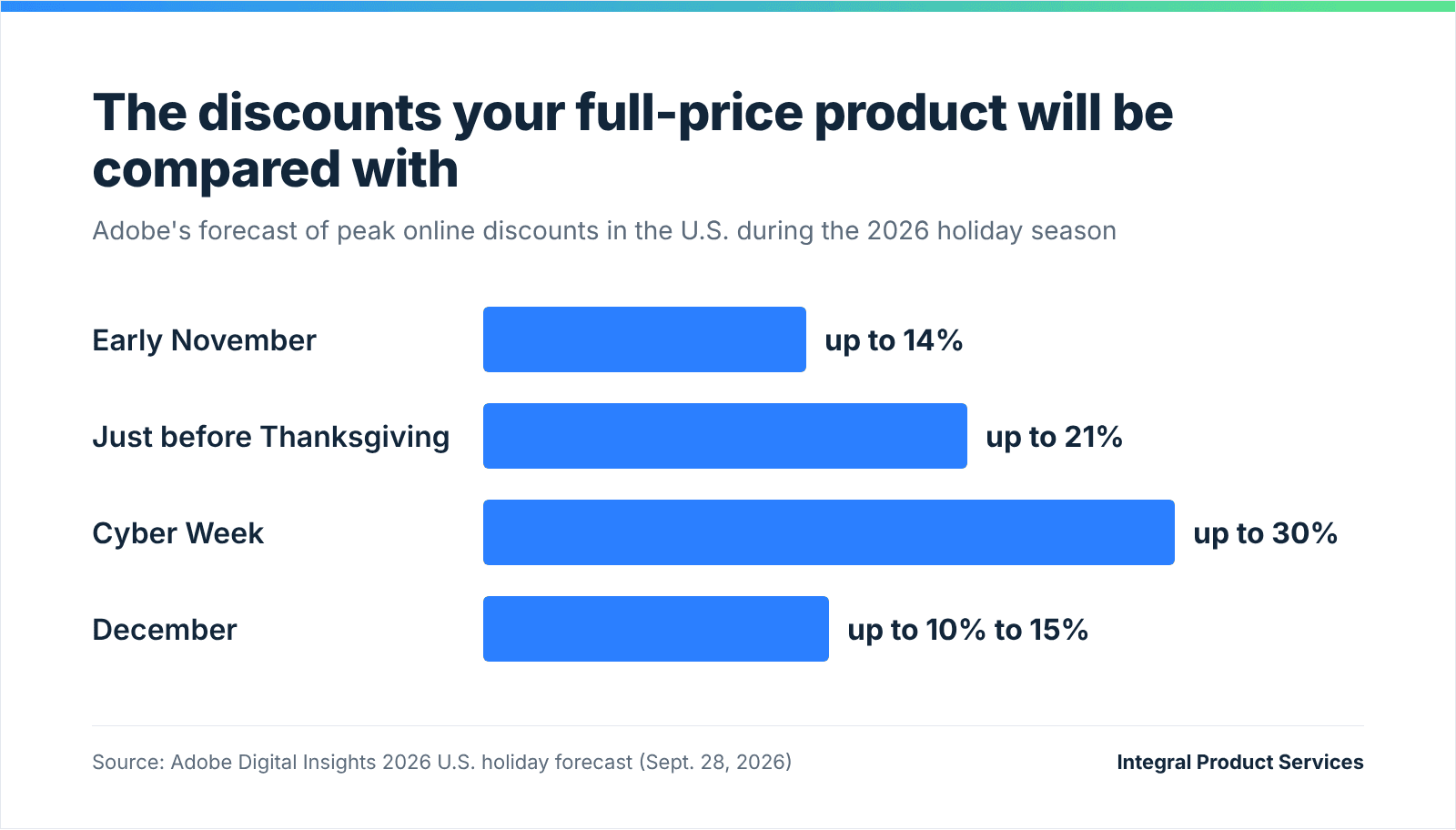
Free to use with credit: you may share this graphic as long as you link back to this article.
Put together, a slow result in December may mean “not this month” rather than “not this product.” That is the honest limit of a holiday test: you cannot fully separate the season from the idea. The reverse is also true. A strong week during Cyber Week can flatter a product that would struggle in an ordinary month.
When can a holiday test tell you something useful?
There are exceptions. If your product is a natural gift, the holidays are when gift interest shows up, and that is real information. Seeing people buy your product for someone else tells you about packaging, the price range that feels right for a gift, and who the buyer really is.
Two cautions apply. First, a gift buyer and an everyday buyer are often different people with different reasons, so a strong December may not repeat in March. Second, most inventors at this stage do not have inventory yet. A pre-order that ships in the spring will not land under a tree, so holiday shoppers may pass even if they like the product. If you test with pre-orders now, judge the result by sign-ups, questions, and repeat visits, not by holiday-level sales. Our article on pre-orders as market research explains what those early signals can and cannot show.
What should an inventor do between now and January?
The weeks before and during the holidays are a good time to prepare the test, even if you run the paid part later.
- Build the assets. Product renderings or photos, a simple website that can collect emails or pre-orders, and analytics that show where visitors come from. These take weeks to do well, and none of them depend on the season.
- Start organic content. Posting on social media costs time rather than ad spend, and it starts building an audience you can reach later. Our article on organic social as a market test covers how to read it.
- Collect emails, not just sales. A “notify me” list gathered in December becomes your first audience in January.
- Plan the paid test for after the holidays. Once the rush ends, ad auctions are typically less crowded and shoppers are no longer comparing every price to a holiday deal. Your numbers should be easier to read.
Doing this well involves several specialties, including design, web, ads, and analytics, and coordinating them is its own job. That is one more reason to start the preparation early rather than rushing it into Cyber Week.
Shoppers are also asking AI for gift ideas
One more shift is worth watching this season. Adobe projects that clicks from AI tools to US retail sites this holiday season will rise 130% compared with last year. Salesforce predicts that AI agents, from shopping assistants to automated bots, will account for 20% of holiday e-commerce traffic.
A brand-new product with no reviews and little written about it is hard for these tools to find. That is not something to fix in a few weeks, but it is a reason to start building clear product pages and gathering honest customer feedback now. We explored this in Shoppers Now Ask AI What to Buy.
Thinking about when to test your product?
At Integral Product Services, we help inventors test the market before they spend on inventory, with renderings, a website that can take pre-orders and collect emails, social campaigns and the analytics to read the results. If you hold a patent or a pending application, you can request a free, no-obligation Patent Review or call us at 813-413-1863.
Not ready for a call? The same page offers our free guide, After You File.
This article is general information, not financial or legal advice. The figures cited are forecasts and predictions by the organizations named and may change.
Sources
- Adobe, “Adobe: U.S. Holiday Shopping Season to Hit Record $275.1 Billion Online, Rising 6.7% YoY,” September 28, 2026.
- Deloitte, “Deloitte Forecasts Holiday Retail Sales to Reach $1.70 Trillion to $1.71 Trillion,” September 10, 2026.
- Salesforce, “2026 Holiday Predictions: A Unified Yet Fractured Journey,” July 20, 2026.
Have a patent or patent pending? Let’s find your next step.
Get a free Patent Review from a Product Launch Specialist. No cost, no obligation, prototype not required.