
Key Takeaways
- A pre-order is stronger evidence than a like, a follow, or a survey answer, because the customer is committing money.
- In an analysis of more than a million pre-orders, the average cancellation rate was 5.4% and the most common wait was 121 to 150 days.
- Charging the card upfront is a stronger demand signal than “reserve now, pay later.”
- Federal rules apply. You need a reasonable basis for any ship date you state, and you must offer refunds if you miss it.
Ask ten friends whether they would buy your product and nine will say yes. Ask them to enter a card number and the room gets quiet.
That gap between what people say and what they do is the reason pre-orders are so useful for a new product. They move the question from opinion to behavior.
What Is a Pre-Order Test?
A pre-order test means offering your product for sale before it exists in inventory, with a clear message about when it is expected to ship. The customer sees realistic product images or video, a price, and a delivery estimate, and decides whether to buy.
For an inventor with a patent and no stock, this is possible because modern 3D renderings can show a product convincingly before a single unit is made. The store page looks like any other product page, with one honest difference: it says the product ships later.
What Does the Data Say?
PreProduct, a company that makes pre-order software for online stores, published an analysis of more than one million pre-orders worth over $85 million. A few of its findings are useful for first-time sellers:
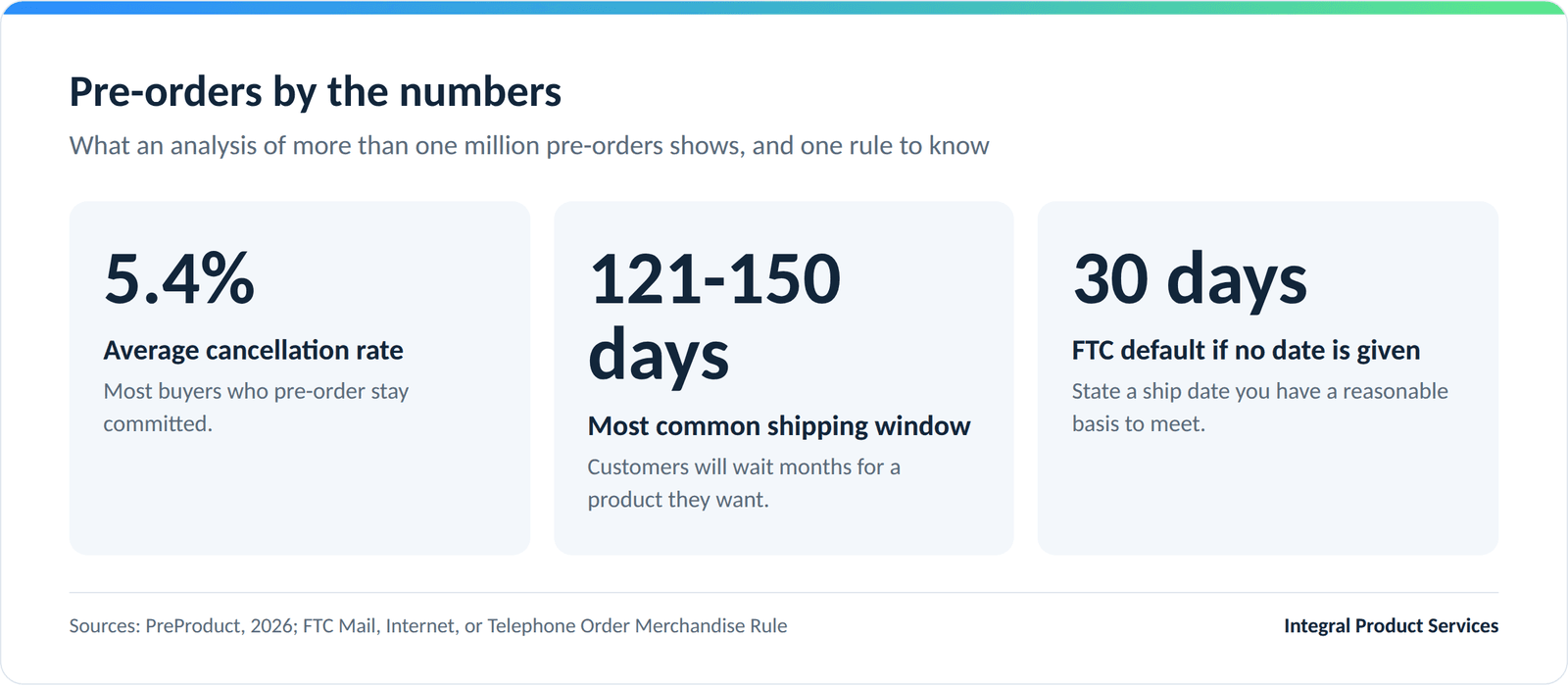
- Average cancellation rate: 5.4%. The large majority of buyers who pre-order stay committed.
- Most common shipping window: 121 to 150 days, which covered 28.1% of pre-orders. Customers will wait four or five months for something they want.
- 43.8% of listings used a charge-later model, where the card is not billed until closer to shipping.
- The $250 and up price band was the largest single category at 26.8% of listings. Pre-orders are not only for inexpensive items.
Keep in mind these figures come from stores already using pre-order software, many of them established brands with existing audiences. A brand-new product with no following should expect smaller numbers. The patterns are what matter.
Charge Now or Charge Later?
This choice changes what your data means.
- Charge upfront. Fewer people will complete the order, but each one is a firm signal. Someone paid real money today for a product arriving months from now.
- Charge later. More people will sign up, but some of them are closer to “interested” than “committed.” Expect more drop-off when the charge goes through.
- Deposit. A middle path. A small payment now, with the balance due at shipping.
If your goal is market research, the stronger signal is usually worth more than the bigger number. Twenty paid orders tell you more than two hundred free reservations.
What Pre-Orders Cannot Tell You
Pre-orders are evidence, not proof. A few limits to keep in view:
- Who ordered matters. Orders from family and friends are kind, but they are not market data. Look at orders from strangers.
- Traffic matters. Ten orders from 300 visitors is a very different story from ten orders from 30,000. You need analytics in place to know which one you have.
- Price is a variable. A product that fails at one price may do well at another. One test at one price is a single data point.
- Small samples swing wildly. Treat early results as a direction, not a forecast.
A flat result is also information. If a fair test at a reasonable price produces very little interest, that is worth knowing before you pay for tooling.
The Rules That Come With Taking Money Early
This part gets skipped in a lot of pre-order advice, and it should not be.
In the United States, the FTC’s Mail, Internet, or Telephone Order Merchandise Rule applies to anything sold online for later delivery. In the FTC’s words, “you must have a reasonable basis for stating or implying that you can ship within a certain time.” If you state no shipping time at all, the default is 30 days.
If you cannot ship when you said you would, the rule requires you to:
- Notify the customer of the delay promptly, with a revised date or a statement that you cannot give one.
- Give them the chance to cancel.
- Refund promptly, without being asked, if they do not agree to the delay.
In practice this means three things. Be conservative with your ship date. Do not spend pre-order money you may need to return. And if you are not ready to commit to manufacturing, consider collecting email signups or small refundable deposits rather than full payment.
Payment processors also have their own policies on long pre-order windows, so check those before launch.
Putting It Together
A useful pre-order test needs several things working at once: convincing product visuals, a store that can take orders and collect emails, a way to bring the right visitors to the page, and analytics that show what those visitors did. None of these is exotic, but each is a separate skill.
Done carefully, the result is a small, defensible set of facts about your product: how many people looked, how many cared, and what they were willing to pay. That is what makes the next decision, whether to manufacture, license, or wait, an informed one.
Curious Whether a Pre-Order Test Fits Your Product?
At Integral Product Services, we set up this kind of test for new inventors before any inventory is made. If you would like to talk about how it might work for your product, reply to our email or visit our contact page.
This article is general information, not legal advice. Review the FTC rule and your payment processor’s terms, or speak with an attorney, before accepting pre-orders.
Sources
FTC: Business Guide to the Mail, Internet, or Telephone Order Merchandise Rule