Key Takeaways
- A patent is a legal right to exclude others from making, using, or selling your invention. It is not proof that anyone wants to buy it.
- Utility patents carry maintenance fees due at 3.5, 7.5, and 11.5 years after grant. Miss one and the patent lapses.
- Only about 40% of patent owners now pay all three fees, the lowest level in two decades, according to an analysis on the patent law blog Patently-O.
- The most useful thing you can do in the first years after grant is find out whether the market cares.
You did the hard part. You had an idea, you documented it, you worked with an attorney or wrote the application yourself, you waited, you answered office actions, and the USPTO said yes.
So why does it feel like nothing has changed?
Because in a commercial sense, nothing has yet. That is not a knock on your patent. It is just what a patent is.
What Does a Patent Actually Give You?
The USPTO describes a patent as protection that prevents others from “copying, making, using, or selling the invention without the inventor’s consent.” Lawyers call it a right to exclude.
Read that again and notice what is missing. A patent does not:
- Give you a product.
- Give you customers.
- Tell you what price people will pay.
- Oblige any company to license it.
What it gives you is a fence. A fence is valuable if there is something inside it that other people want. The patent office examines whether your invention is new and non-obvious. It never asks whether it will sell.
The Clock That Starts at Grant
Here is something many first-time patent holders learn late. A US utility patent generally lasts 20 years from its filing date, but only if you keep paying for it.
The USPTO requires maintenance fees on utility patents at three points after the issue date:
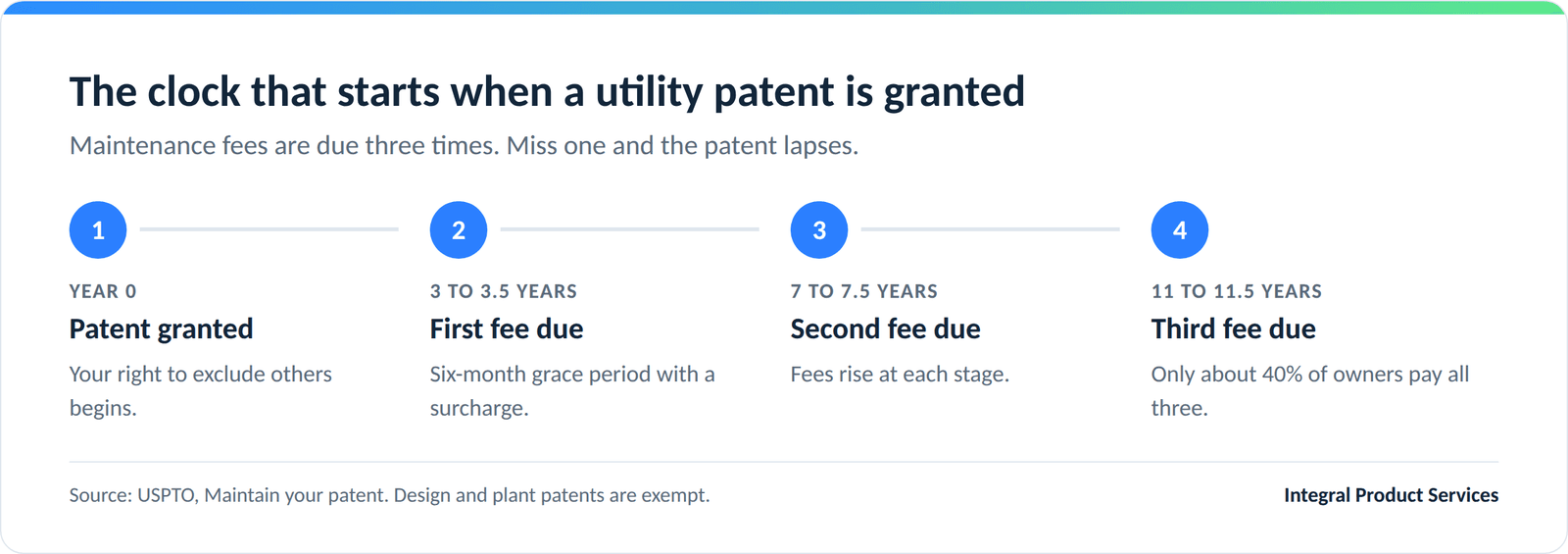
- 3 to 3.5 years after grant
- 7 to 7.5 years after grant
- 11 to 11.5 years after grant
Each has a six-month grace period with a surcharge. After that, the USPTO’s guidance is blunt: “patent protection lapses and the rights provided by a patent are no longer enforceable.” The office sends reminders, but it also states that failing to receive one does not excuse a missed payment.
Design patents and plant patents do not carry maintenance fees. If you are unsure which type you hold, your grant paperwork or your attorney can tell you in a minute.
The fees rise at each stage, with discounts for small and micro entities. The current amounts are on the USPTO fee schedule.
Most Patents Are Quietly Abandoned
In March 2026, law professor Dennis Crouch published an analysis on Patently-O showing that only about 40% of patent owners now pay all three maintenance fees. That is down from roughly 52% a decade ago and is the lowest level in twenty years.
Think about what that means. The majority of patent owners, including large companies with legal departments, reach a point where they decide a given patent is not worth the next payment.
They are making a business decision: is this patent earning, or likely to earn, more than it costs to keep? For a company with sales data, that is easy to answer. For an independent inventor with no sales and no market data, it is a guess.
That first payment window opens three years after grant. It is a natural deadline for having real information in hand.
What Holds Inventors Back Is Usually Not the Fees
When the USPTO studied its own fee structure for Congress, it concluded that fees are not what discourages small and micro entities. Factors outside the patent office drive those decisions, and the report pointed to outreach and support as more helpful than fee changes.
That matches what we have seen over our careers, and in our first few years as a company. Inventors rarely stall because of a government fee. They stall because the next step is unclear, every option seems to cost a lot, and nobody can tell them whether the product will sell.
What Is the Missing Piece?
Commercial proof. Whichever road you eventually take, the people on the other side of the table will ask the same question.
- A licensing prospect wants to know if consumers respond to the product.
- An investor or lender wants to see demand and a realistic cost to produce.
- You, if you plan to manufacture and sell it yourself, need to know the price the market will bear before you order anything.
None of that is in the patent. All of it can be explored without building inventory, using product visuals, a simple website, social content, and analytics that show who is interested and at what price.
A word of caution: a market test can come back with an answer you do not want. Low interest at every price point is a real possible result. It is still far better to learn that from a modest test than from a garage full of stock, and it makes that three-and-a-half-year decision an informed one.
Wondering What to Do With Your Patent?
At Integral Product Services, we work with inventors who already hold a patent and want to find out what the market thinks before spending heavily. If that is where you are, reply to our email or visit our contact page.
This article is general information, not legal advice. Confirm your patent type, deadlines, and fees with a registered patent attorney or the USPTO.