
Key Takeaways
- Landed cost is the full cost of a product by the time it reaches the buyer: manufacturing plus freight, duties, shipping, fees, and overhead.
- It is often two or three times the factory price. In Shopify’s own worked example, a $2 manufacturing cost becomes a $6.38 landed cost.
- In 2026, import duties of 10% or 12.5% on goods from most trading partners, and the end of the $800 duty-free exemption, make this number higher and harder to guess.
- A documented cost estimate from a real manufacturer shows licensing partners and investors that the product is buildable at a price the market can support.
Ask an inventor what their product will cost to make and you will usually get one of two answers. Either “I’m not sure yet,” or a confident figure based on the materials in the prototype.
Both leave the same gap. And it is a gap that the people you will eventually pitch to notice right away.
What Is Landed Cost?
Shopify defines it simply: “Landed cost is the total cost invested in a product by the time it’s delivered to a buyer.”
It breaks that total into five parts:
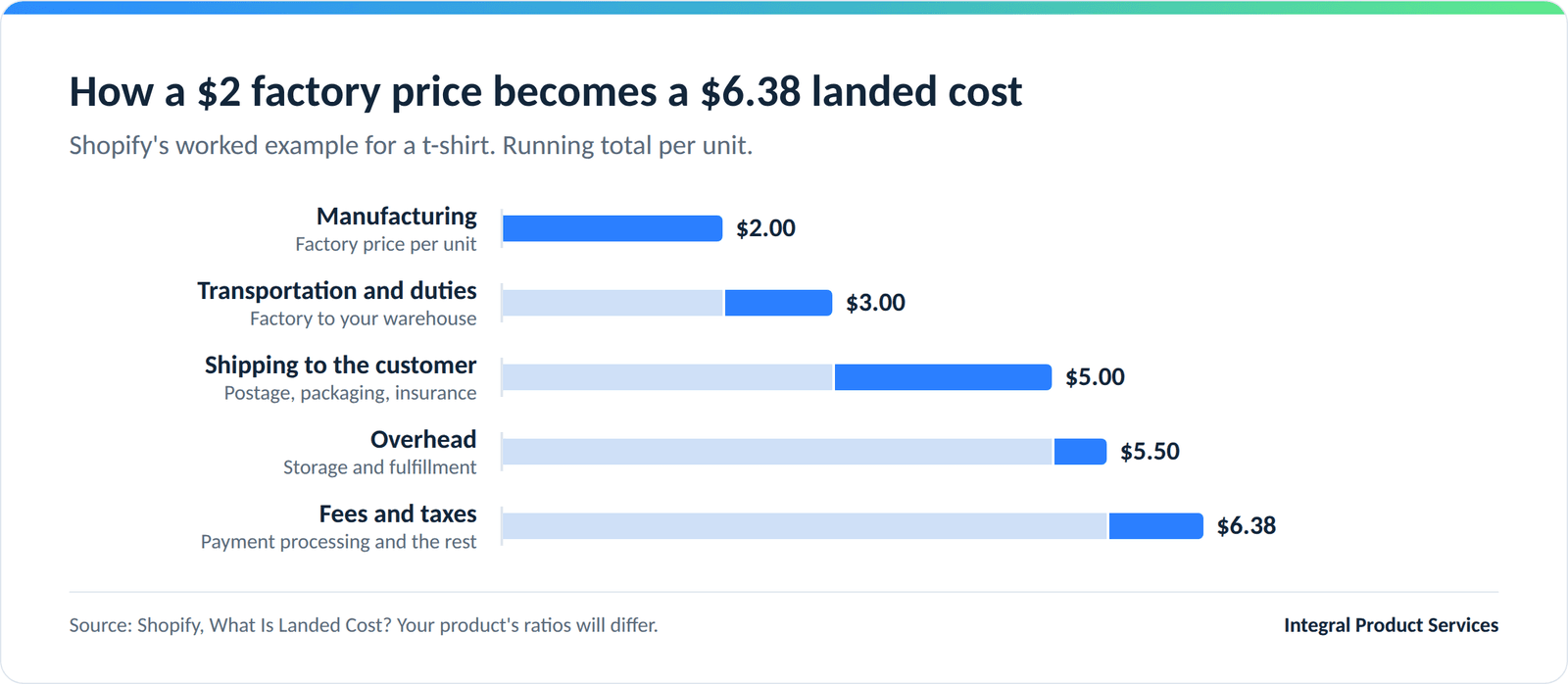
- Manufacturing. What the factory charges per unit.
- Transportation, import duties, and fees. Getting the goods from the factory to your warehouse.
- Shipping to the customer. Postage, packaging materials, and insurance.
- Overhead. Storage, fulfillment partners, and similar running costs, spread across units.
- Remaining fees and taxes. Payment processing, marketplace fees, and the unexpected.
Shopify’s illustration uses a t-shirt that sells for $20. The manufacturing cost is $2. Add $1 for transportation, $2 for shipping, $0.50 for overhead, and $0.88 in transaction fees, and the landed cost is $6.38, more than three times the factory price.
The exact ratios will differ for your product. The lesson holds: the factory quote is where the cost conversation starts.
Why 2026 Makes This Harder
Two changes have pushed the “duties” line up and made it less predictable.
- Tariffs. Since July 24, 2026, Section 301 tariffs of 10% or 12.5% apply to imports from 60 trading partners covering roughly 99% of US imports, according to the law firm Morgan Lewis. They replaced a temporary 10% duty, which itself replaced tariffs the Supreme Court struck down in February. The current tariffs are already being challenged in court.
- The end of de minimis. Until August 2025, shipments valued at $800 or less entered the US duty-free. That exemption is gone. Small sample orders and first production runs from overseas now incur duties.
For an inventor, the practical effect is that a cost estimate has a shelf life. A figure from last year may be meaningfully wrong now. It also puts domestic and nearby manufacturing options back on the table for some products that would not have considered them before.
Why Do Licensing Partners Care About Your Cost?
You might think cost is the licensee’s problem. They have the factories, after all.
But recall what companies check before licensing an outside invention. A July 2026 report on the subject listed buildable design and market fit among the four criteria. Market fit, as the report describes it, includes whether the product suits the sales channels and price points the manufacturer already works with.
That is a cost question in disguise. If a company’s customers expect to pay $25 for items in your category, and your product cannot be made for a cost that supports a $25 shelf price, the conversation ends no matter how clever the invention is.
Retail pricing works backward from the shelf. The retailer takes a margin, the brand takes a margin, and what is left has to cover landed cost. A common rule of thumb is that a product needs to retail for several times its landed cost to work through traditional retail channels. Products that look viable at a glance often fail this test.
If you arrive with a documented estimate, you have answered the question before it is asked. It signals that you understand their business, and it removes a reason to say no.
What Does a Credible Cost Estimate Include?
A number on its own is not persuasive. What carries weight is a number with its working shown:
- A clear product specification. Materials, dimensions, components, finishes, and packaging, organized so that any factory could quote from it.
- Quotes from real manufacturers, ideally more than one, at realistic order quantities. Per-unit cost usually falls as volume rises, so show it at a few quantity levels.
- Tooling and setup costs listed separately. Molds and fixtures are one-time expenses that can be significant.
- An allowance for freight and duties based on current rules and the likely country of origin.
- The date. Given how quickly trade rules are moving, an estimate should say when it was prepared.
Finding and vetting manufacturers is its own skill. Response rates to unknown first-time buyers can be poor, quotes can vary widely for the same specification, and comparing them fairly takes some experience.
How Cost Connects to Your Market Test
Cost is half of a simple equation. The other half is what customers will pay.
If a market test shows people will pre-order at $49 and your landed cost estimate is $11, you have room for a business or an attractive licensing proposition. If the test shows resistance above $19 and the landed cost is $11, you have learned something equally important, before tooling up.
Neither number means much alone. Together they tell you whether there is a business here, and they are the first two things a serious partner will want to see.
A Note on What an Estimate Is
An estimate is a planning tool, not a guarantee. Quotes change, material prices move, and tariffs, as this year has shown, can shift with little warning. Treat any figure as a well-informed snapshot and update it before making commitments.
Need a Realistic Cost Figure for Your Product?
At Integral Product Services, we work with vetted manufacturers to prepare cost analyses and product summaries that inventors can use in licensing and investor conversations. To talk about your product, reply to our email or visit our contact page.
This article is general information, not trade, tax, or financial advice. Confirm current duty rates with a licensed customs broker before making sourcing decisions.