Key Takeaways
- Companies that license outside inventions tend to check four things: proof of function, protectable IP, a buildable design, and market fit.
- Most of that review happens from renderings, CAD files, and pitch materials, so a physical prototype is often not the first thing you need.
- A patent covers one of the four. The other three are things you have to show.
- Even a well-prepared pitch often gets no reply. Preparation improves your odds; it does not guarantee a deal.
Licensing sounds simple from the outside. You own the patent, a company with factories and shelf space pays you a royalty to use it, and everyone wins.
The hard part is the first conversation. The person reading your pitch has a full inbox, a product roadmap that was set months ago, and very little time. What they look at in that short window matters a great deal.
What Do Companies Check First?
A report published in July 2026, drawing on the experience of the Minnesota product development firm Enhance Innovations, listed four things manufacturers evaluate before licensing an outside invention:
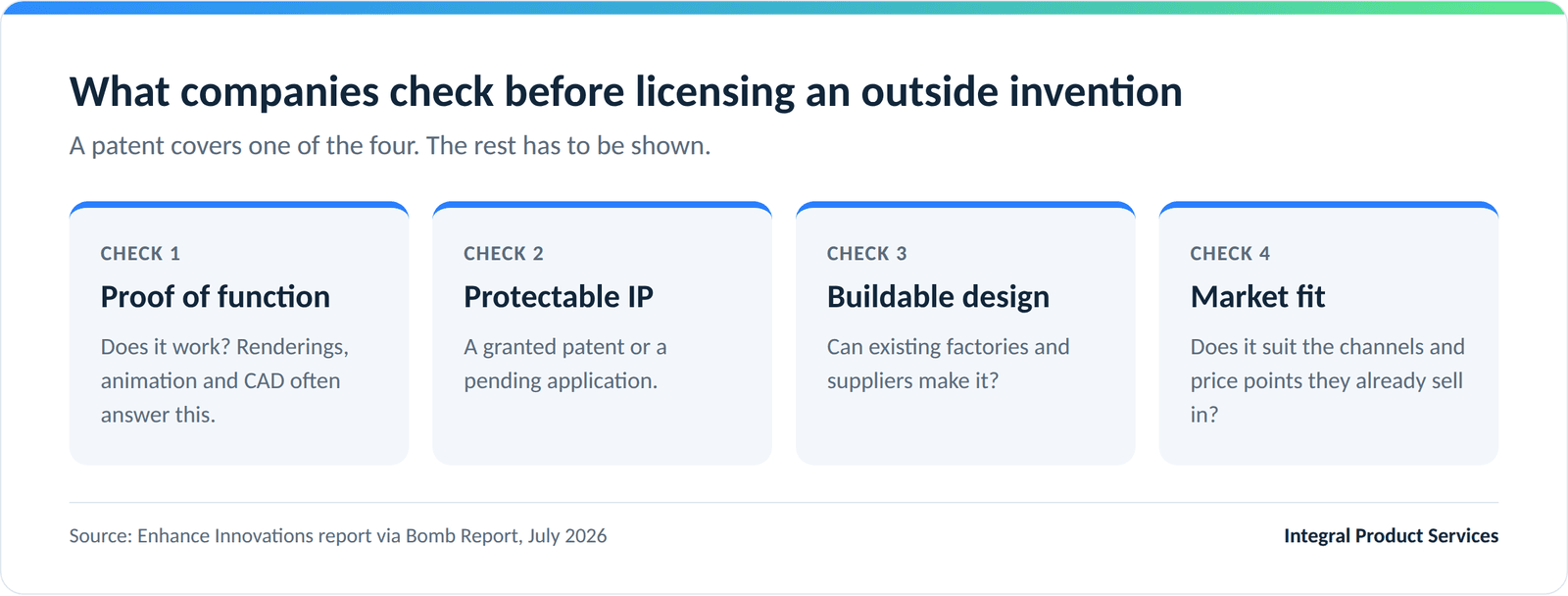
- Proof of function. Does it work, and can I see that it works?
- Protectable IP. Is there a patent or at least a pending application?
- Buildable design. Can our existing factories and suppliers make this?
- Market fit. Does it belong in the channels and price points we already sell through?
Notice what is on that list and what is not. Nobody asked whether the idea is clever. They asked whether it is low-risk for them.
Do You Need a Physical Prototype to License a Product?
Often, no. This is the finding that surprises inventors most.
The same report noted that a well-built virtual package, meaning photorealistic renderings, a product animation, and a CAD model, answers the “does it work” question for most consumer products without a single molded part. Engineers on the company’s side can open a CAD file and judge whether the design is producible before anyone schedules a meeting.
Licensing coach Stephen Key of inventRight has made a similar point for years. His advice is to test interest first with a one-page sell sheet and a short problem-and-solution video, and to invest in prototyping only once a company shows interest.
There are exceptions. If your product’s whole value is a mechanism that people will doubt until they see it move, or it touches safety or medical use, a working model may be unavoidable. For most household, hobby, pet, fitness, and tool products, clear visuals do the early work.
Where Does Your Patent Fit In?
You already have the second item on the list. That is a real advantage, because many inventors approach companies with only a provisional application.
But look at the other three. A patent does not show that the product works, that it can be made at a sensible cost, or that anyone wants it. Those have to be demonstrated separately:
- Function is shown with renderings, animation, and an interactive 3D model that lets a reviewer turn the product around and see how it operates.
- Buildability is shown with a clean product summary covering materials, dimensions, and specifications, ideally alongside a manufacturing cost estimate from a real factory.
- Market fit is shown with evidence that real people respond to the product. Website traffic, email signups, social engagement, and pre-orders all count, even in modest numbers.
That last one is where most pitches are thin. A company can estimate its own production cost. What it cannot easily get is an early read on whether consumers care. If you bring that, you have given them something they did not already have.
What a Licensing Pitch Usually Contains
Putting it together, a credible package tends to include:
- A one-page sell sheet that leads with the consumer benefit, not the patent claims.
- Photorealistic images and a short video.
- A simple website or pitch page a decision-maker can open from an email.
- A summary of any market response you have gathered.
- A short, specific note on why this product fits that company’s line.
Each piece is a different specialty: industrial design, 3D work, web, copywriting, market research, and outreach. Coordinating them is a job in itself, which is one reason so many patents never get pitched at all.
The Part Nobody Likes to Say
Licensing is a low-percentage game even when you do everything right. One older survey cited by the legal publisher Nolo found that only about 13% of inventors who tried to license their invention succeeded. Treat that figure as a rough guide rather than a current statistic, but the direction is accurate.
Most outreach gets no reply. A “no” is normal and usually has more to do with the company’s roadmap than with your idea. Timing, category trends, and plain luck all play a part.
What preparation does is keep you out of the pile that gets dismissed in ten seconds. It does not promise a deal, and you should be cautious of anyone who says it does.
Thinking About Licensing Your Product?
At Integral Product Services, we help new inventors build these materials and gather market evidence before any outreach begins. If you would like to talk about what a licensing package could look like for your product, reply to our email or visit our contact page.
This article is general information, not legal advice. Talk to a patent attorney before sharing confidential details or signing a licensing agreement.