Key Takeaways
- US importers have lived under three different tariff systems in 2026, and the current one is already being challenged in court.
- For a new product, that makes your per-unit cost a moving target, and cost is only half of the equation anyway.
- The half you can pin down today is demand and the price people will pay, and you can measure both before a single unit is made.
- Pre-orders and digital testing give useful signals, but they come with real obligations and real limits.
If you hold a patent on a new product, the natural next thought is: let’s get it made. It is the most tangible step, and it feels like progress.
This year has given inventors a very good reason to slow down on that step. Not to stop, but to change the order of operations.
What Actually Happened With Tariffs in 2026
Here is the short version, because the headlines have been hard to follow.
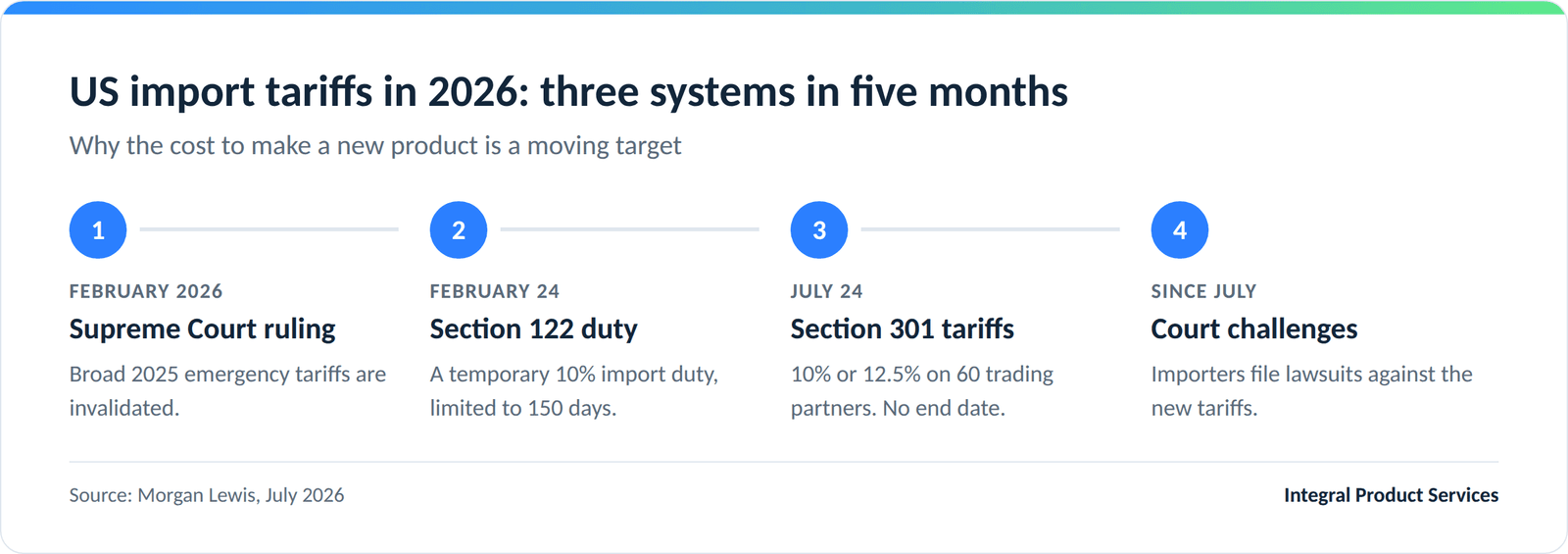
- February 2026: The Supreme Court invalidated the broad tariffs that had been imposed in 2025 under emergency powers.
- February 24: The administration replaced them with a temporary 10% import duty under a different law, Section 122, which carries a 150-day limit.
- July 24: That duty expired, and new Section 301 tariffs of 10% or 12.5% took effect the same day, covering 60 trading partners that account for roughly 99% of US imports, according to an analysis by the law firm Morgan Lewis. These have no set end date.
- Since then: Importers have already filed lawsuits challenging the new tariffs.
Separately, the de minimis exemption, which used to let packages worth $800 or less enter the US duty-free, ended in August 2025. Small sample orders and small-batch shipments from overseas now carry duties they did not carry before.
None of this is a political point. It is a planning point. The rules that set your cost to import a product have been replaced twice in five months, and may change again.
Why This Hits First-Time Inventors Harder
An established brand can absorb a 10% swing in landed cost. It has existing sales, supplier relationships, and pricing history to work with.
A first-time inventor has none of that. If you order inventory today, you are locking in three guesses at once:
- A cost guess, based on tariff rules that are in active litigation.
- A price guess, based on what you hope customers will pay.
- A demand guess, based on the belief that enough people want it.
If any one of those is off, the margin you planned on can disappear. And inventory, once it is sitting in a garage or a warehouse, is very hard to undo.
The Half of the Equation You Can Pin Down Now
You cannot control trade policy. You can find out, fairly cheaply, whether people want your product and what they will pay for it.
A digital market test usually involves a few connected pieces:
- A realistic visual of the product, often a 3D rendering or video, so people can react to something concrete.
- A simple branded website where visitors can join a list or place a pre-order.
- Social media content that puts the product in front of the kind of people it was designed for.
- Analytics that record what happens: who visits, who signs up, who is willing to buy, and at what price.
The output is not a guarantee of anything. It is evidence. And evidence is what turns a cost conversation from “can we afford to make this?” into “at this price and this level of interest, what can we afford to pay per unit?”
That second question is much easier to answer, even when tariffs move.
What Pre-Orders Can and Cannot Tell You
Pre-orders are one of the stronger signals available, because people are committing money rather than clicking “like.”
The pre-order software company PreProduct analyzed more than a million pre-orders and found an average cancellation rate of 5.4%. The most common shipping window was 121 to 150 days. In other words, buyers will wait months for a product they want, and most of them stay committed.
A few cautions belong here:
- Pre-orders are a promise. The FTC’s Mail, Internet, or Telephone Order Merchandise Rule requires a reasonable basis for any ship date you state. If you cannot meet it, you must notify buyers and offer a refund.
- Charging later is a weaker signal than charging now. A reservation with no card charged tells you less than a paid order.
- Small numbers can mislead. A handful of orders from friends and family is encouragement, not data.
The Same Evidence Works for Licensing
Not every inventor wants to manufacture at all. Many would rather license the patent to a company that already has factories and shelf space.
The evidence still matters. A July 2026 report on what manufacturers look for before licensing an outside invention listed four things: proof of function, protectable IP, a buildable design, and market fit. It also noted that companies typically evaluate these from renderings, CAD models, and pitch materials, not from physical prototypes.
You already have the protectable IP. Demand data speaks directly to market fit, which is the part a patent alone cannot prove.
A Realistic Order of Operations
Based on what we have seen over our careers, and in our first few years as a company, this sequence carries the least risk:
- Test digitally. Measure interest and price tolerance.
- Read the data. Be willing to hear “not yet” or “not at this price.”
- Then decide. Prototype and manufacture, approach companies about licensing, or keep building an audience.
This approach does not guarantee a successful product. Nothing does, and anyone who tells you otherwise deserves a second look. What it does is make sure that when you spend serious money, you are spending it on something the market has already responded to.
Want to Talk Through Your Product?
At Integral Product Services, this test-first sequence is how we work with new inventors. If you would like to talk about where your product stands, reply to our email or visit our contact page.
This article is general information, not legal, tax, or trade advice. Tariff rules are changing quickly; confirm current rates with a customs broker before making sourcing decisions.
Sources
- Morgan Lewis: US Administration Rebuilds Global Tariff Program Under Section 301 (July 2026)
- Practical Ecommerce: Ecommerce after De Minimis Tariff Exemption
- PreProduct: How to Run a Pre-order Campaign (2026)
- FTC: Business Guide to the Mail, Internet, or Telephone Order Merchandise Rule
- Bomb Report: What Manufacturers Look For Before Licensing an Outside Invention (July 2026)