Key Takeaways
- Licensing trades most of the profit for very low cost and risk. Building it yourself keeps the profit and control, along with all the cost, work, and risk.
- Five questions settle most of the decision: capital, time, risk tolerance, desire for control, and what your market data shows.
- The decision is much easier, and a partner much easier to persuade, once you have evidence of demand and a realistic cost figure.
- There is a third option that is often the wisest: keep testing, or stop. Both are legitimate outcomes.
Most inventors begin with a preference. Some dream of seeing their own brand on a shelf. Others want nothing to do with running a company and hope to license the patent and move on to the next idea.
A preference is a fine starting point. It should not be the deciding factor. The better approach is to look squarely at what each road demands and what your own evidence supports.
The Two Roads, Side by Side
The legal publisher Nolo summarizes the trade-off well. With licensing, “the licensee assumes all the business costs and risks, from manufacturing to marketing.” The price of that safety is a much smaller share of the revenue and little say in how the product is made or sold.
| Licensing | Building it yourself | |
| Capital needed | Low. Mainly pitch materials and outreach. | High. Tooling, inventory, marketing, operations. |
| Your time | Modest once a deal is signed. | A second job, at minimum. |
| Control | Little. The licensee decides design, price, and marketing. | Full. |
| Earnings per unit | Small. Commonly mid-single-digit percent of net sales for consumer goods. | Much larger, after you cover all costs. |
| Risk | Low financial risk; high chance of no deal. | High financial risk; the outcome is in your hands. |
Five Questions to Ask Yourself
1. How much capital can you put at risk? Not how much you can raise, but how much you could lose without harming your household. Manufacturing requires money for tooling and inventory before the first sale, and this year’s tariff changes have made that figure harder to predict.
2. How much time do you have? Running a product business means customer service, reordering, shipping problems, and marketing every week. If you have a demanding career and no wish to leave it, that matters.
3. How do you handle risk? Some people are energized by it and some lose sleep. Neither is a flaw. Be truthful with yourself about which you are.
4. How much does control matter to you? If you would be unhappy watching a licensee change your design, cheapen the materials, or pick a name you dislike, licensing may frustrate you even if it pays.
5. What does your data say? This is the question most inventors cannot yet answer, and it is the one that should carry the most weight.
How Market Data Points the Way
Evidence from a market test does not make the decision for you, but it narrows it considerably.
- Strong demand, healthy margin, affordable customer acquisition. The numbers support building it yourself, if your answers to the first four questions allow it. The same evidence also makes for a compelling licensing pitch if you would rather not.
- Strong demand, but expensive to reach customers. With the average Google Ads click now above $5 according to WordStream’s latest benchmarks, this is common. It favors licensing to a company that already has the audience and the shelf space.
- Demand only at a low price, with a high cost to produce. A large manufacturer with buying power may be able to make the numbers work when you cannot. That points toward licensing, or back to the drawing board on cost.
- A niche but passionate audience. Often too small to interest a large licensee, yet perfectly viable as a small direct-to-consumer business.
- Weak demand across the board. See the third option below.
What Each Road Requires You to Prove
Whichever direction you lean, someone will need convincing, even if that someone is you.
For licensing, companies look for proof of function, protectable IP, a buildable design, and market fit, according to a July 2026 report on how manufacturers evaluate outside inventions. In practice that means strong visuals, your patent, a product specification with a cost estimate, and evidence that consumers respond.
For building it yourself, a lender, an investor, or your own savings account wants to see a plan: the size of the market, the cost to produce, the price the market accepts, the cost to win a customer, and how long until the business pays for itself.
The overlap between those two lists is large. Product visuals, demand evidence, and a cost figure serve both. That is the practical argument for gathering them first and choosing the road second. You are not delaying the decision. You are preparing for either outcome at once.
The Third Option: Not Yet, or Not at All
Most advice on this topic assumes you must pick a road. You do not.
Keep testing. If your data is thin or mixed, more time building an audience through organic content costs little and can strengthen your position for either path. An engaged following is leverage in a licensing negotiation and a customer base for a launch.
Stop. If a fair test at several prices shows little interest, the most financially sound decision may be to let this one go and put your energy into the next idea. That is a hard thing to hear about something you have patented. It is also the entire point of testing before spending heavily. A modest test that prevents a large loss has done its job.
We say this plainly because we think inventors deserve to hear it. Licensing deals are hard to land. One older survey cited by Nolo found only about 13% of inventors who tried succeeded. Product businesses are hard to build. Nobody can guarantee either outcome. What you can control is how much you know before you commit.
Where to Start
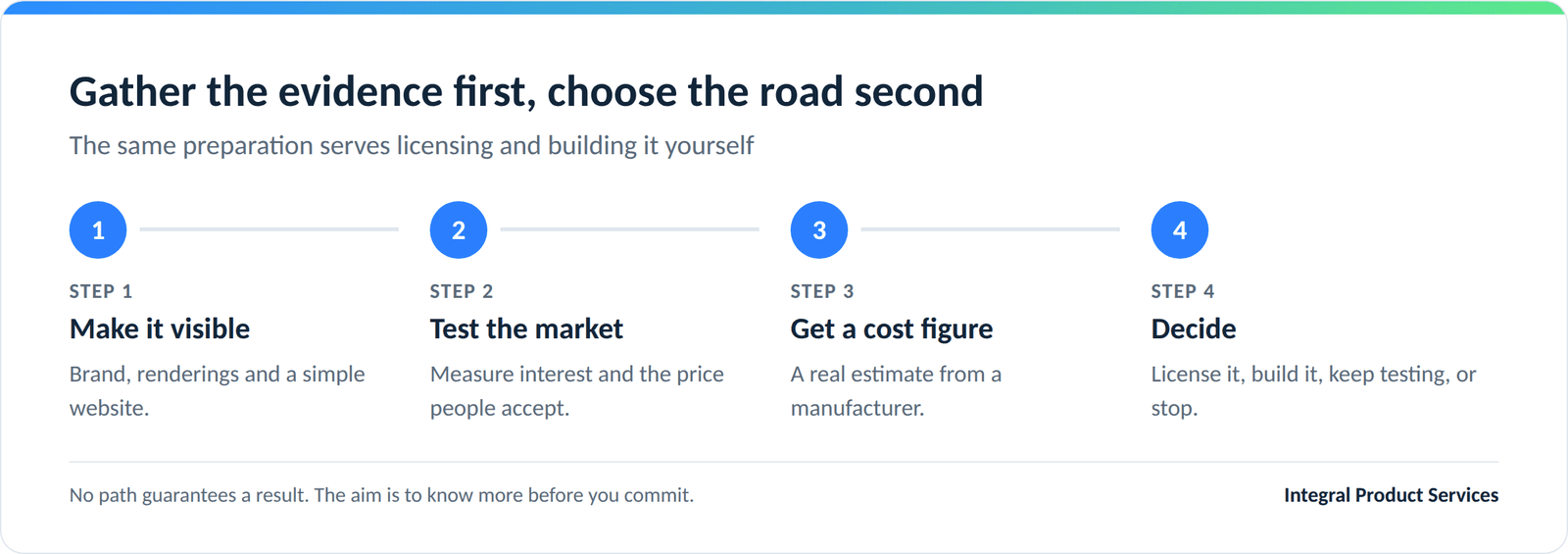
Based on what we have seen over our careers, and in our first few years as a company, the order that protects inventors best is the same regardless of which road they end up on: make the product visible, test the market, get a real cost figure, and then decide with evidence in hand.
Want to Talk Through Your Options?
At Integral Product Services, we help new inventors gather that evidence first and then plan the next step, whether that is licensing outreach, production, or more testing. To talk about your product, reply to our email or visit our contact page.
This article is general information, not legal or financial advice. Consult a qualified attorney and financial advisor before making significant business decisions.
Sources
- Nolo: Should You License or Manufacture Your Invention?
- Bomb Report: What Manufacturers Look For Before Licensing an Outside Invention (July 2026)
- Search Engine Land: Google Ads costs keep rising, but conversion rates improved in 2025 (May 2026)
- Stanzione & Associates: Average Patent Royalty Rates by Industry for 2026