Key Takeaways
- Social platforms are now real sales channels for small businesses. TikTok Shop alone reported small business sales up 66% in 2025.
- Organic posting, meaning content you do not pay to promote, works as a slow but very low-cost market test.
- The signals that matter are the ones that take effort: saves, shares, comments asking about price or availability, and clicks to your site.
- Follower counts and likes are weak evidence. A small audience of the right people beats a large audience of the wrong ones.
Large companies pay research firms to put products in front of consumers and record their reactions. Independent inventors rarely have that budget.
What they do have is access to the same consumers, on the same platforms, for free. It is slower and messier than formal research, but the reactions are real, and they come from people who were not paid to have an opinion.
Social Media Is Where Small Products Get Discovered
The scale here is no longer in doubt. In May 2026, Modern Retail reported figures shared by TikTok Shop showing that:
- Sales from US small businesses on the platform rose 66% in 2025.
- More than 215,000 small businesses were actively selling there, up 25% from the year before.
- Total US sales on TikTok Shop exceeded $14 billion in 2025, according to estimates from analytics firm Charm.io.
The IBM and National Retail Federation consumer study published in January 2026 found that 29% of shoppers want “effortless purchasing through social platforms.” People are comfortable discovering, judging, and buying products without leaving their feed.
You do not have to sell on any of these platforms to benefit. For a product still in the testing stage, their value is as a window onto how strangers react.
What Does an Organic Market Test Look Like?
“Organic” simply means content you post without paying to promote it. A basic test has a few parts:
- Branded accounts on the platforms your likely customers use. For most consumer products that means Facebook, Instagram, and TikTok.
- A steady run of content over weeks, not days. Short videos and images showing the product, the problem it solves, and how it works.
- Variety on purpose. Different angles on the same product: the frustration it removes, the time it saves, how it looks, who it is for.
- A destination. A link to a website where interested people can sign up or pre-order, so interest turns into something you can count.
For a product that does not physically exist yet, 3D renderings and animations make this possible. A well-made rendered video is often indistinguishable from footage of a real product and lets you show the item in use.
Which Signals Matter?
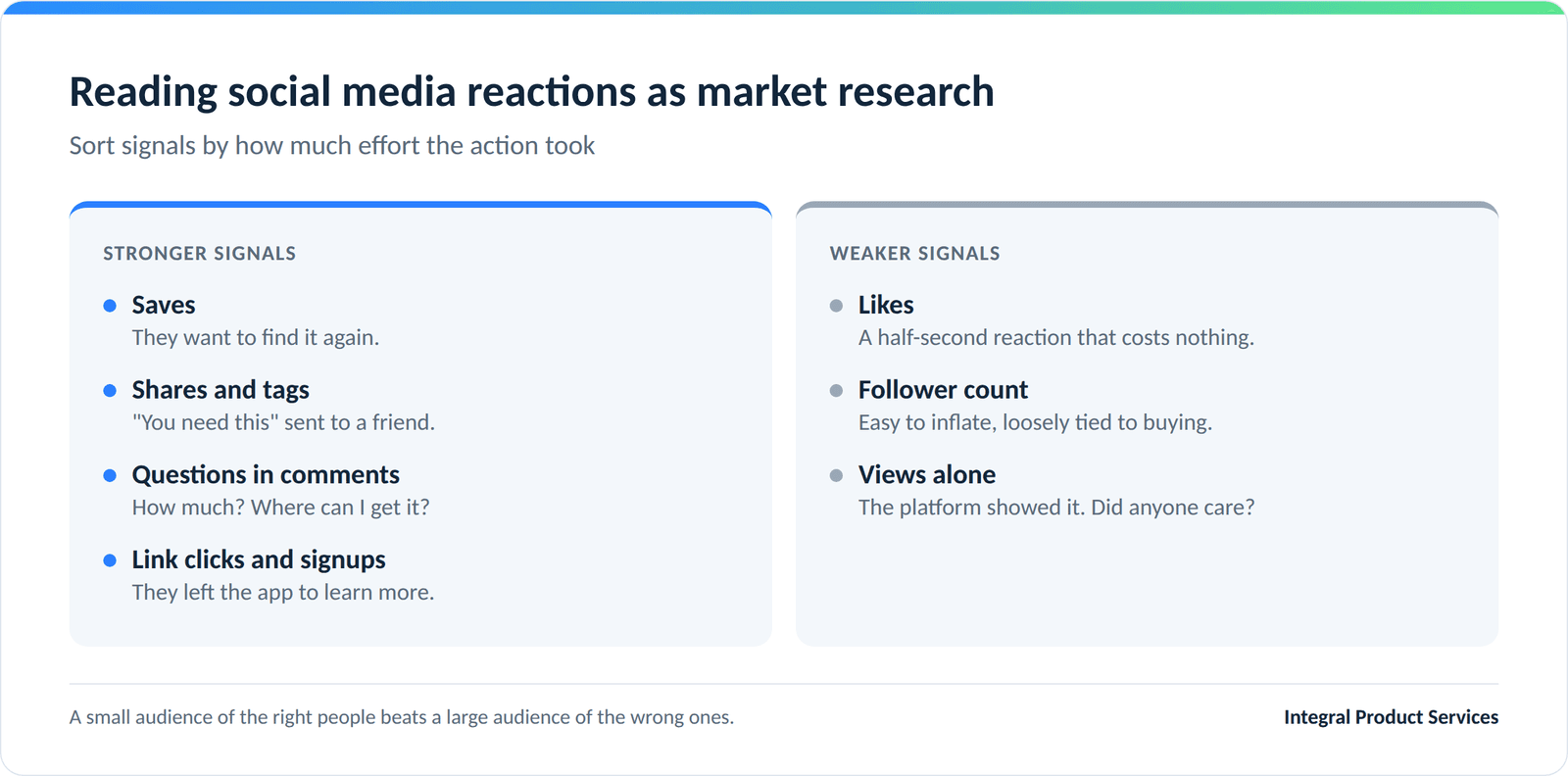
Not all engagement is equal. A useful way to sort it is by how much effort the action takes.
Stronger signals
- Saves. Someone wants to find this again. That is intent.
- Shares and tags. “You need this” sent to a friend is the best free advertising there is, and it tells you who the product is for.
- Comments with questions. “How much?” “Where can I get it?” “Does it come in a larger size?” These are buying questions.
- Link clicks and signups. They left the app to learn more. That is effort.
Weaker signals
- Likes. A half-second reaction that costs nothing.
- Follower count. Easy to inflate and loosely related to purchase intent.
- Views alone. Reach tells you the platform showed it, not that anyone cared.
Comments also give you something numbers do not: words. The phrases people use to describe your product and their problem are the phrases you should be using on your website and in any future advertising. Objections are just as useful. If ten people ask whether it fits a certain size, or say it looks expensive, you have learned something a survey would not have surfaced.
What About Someone Stealing the Idea?
This is a reasonable worry and one we hear often. It is also the main reason this approach suits inventors who already have a patent granted or an application on file. Public disclosure before filing can damage your rights. After filing, showing the product publicly is a normal part of bringing it to market.
If you are unsure where you stand, a short conversation with your patent attorney before posting is worth the time.
The Limits of Organic Testing
It would be misleading to present this as a shortcut, so here are the limits.
- It is slow. New accounts start with no audience. It commonly takes weeks of consistent posting before platforms show your content to meaningful numbers of people.
- It is uneven. One post may reach thousands and the next fifty. Judge the trend over a month or more, not any single post.
- It takes consistent effort. A reasonable cadence is several posts a week, each needing visuals and copy. This is the part most solo inventors find hardest to sustain.
- It is directional. Organic response tells you whether interest exists and with whom. It will not give you a sales forecast.
Many tests pair organic posting with a small paid budget to speed things up. The organic side shows which content resonates, and paid promotion puts the best of it in front of a defined audience to see whether the response holds.
Turning Attention Into Evidence
Attention on its own does not pay for anything. The point of the exercise is to convert it into facts you can use. How many people clicked through? How many joined the list? How many placed a pre-order, and at what price?
Those numbers are what inform a decision to manufacture. They are also what make a licensing pitch more persuasive, because they answer a question a company cannot easily answer for itself: do consumers respond to this?
Want Help Setting Up a Social Market Test?
At Integral Product Services, we build the branded accounts, visuals, and content that let new inventors test their product in front of real audiences. To talk about yours, reply to our email or visit our contact page.
This article is general information, not legal advice. Speak with your patent attorney about public disclosure before posting an invention that is not yet covered by a filed application.