
Part of our guide Making Your Product, which puts every article on this topic in the order you will need them.
Key takeaways
- The US no longer lets small packages worth $800 or less in duty-free, so prototype samples shipped from overseas now pay import duties and fees like any other import.
- On a sample from China, several layers can stack: the normal duty rate, the 2018-2019 China tariffs, and a 12.5% tariff added in July 2026, plus entry and carrier fees.
- The special duty-free rules for “samples” are written for goods used to take orders, so they usually do not cover a prototype you are evaluating.
- The cheapest sample round is the one you skip: settling the design digitally first and consolidating shipments both cut the bill.
Many inventors who work with an overseas factory go through several rounds of samples before the design is right. Until recently, a small box from a supplier usually arrived without any extra charge. That changed, and some first-time inventors find out when a courier asks for payment before delivery.
This matters most early, when you may need three or four sample rounds and your budget is smallest. Here is what changed, what a sample can now cost, and how to keep the number down.
What changed for small packages?
For years, the de minimis rule let shipments valued at $800 or less into the US free of duty. An executive order suspended it for goods entered from August 29, 2025, and a February 2026 order continued that suspension for all countries.
In June 2026, US Customs and Border Protection (CBP) issued rules that suspend the exemption indefinitely. For courier and freight shipments, CBP’s rule says all entries of merchandise valued at $800 or less “must utilize formal or informal entry procedures.” A separate rule set up a new entry process for international mail, with further requirements that apply from October 22, 2026. And Congress has written the end of the exemption into law, effective July 1, 2027.
In plain terms: a sample is now an import. Someone has to file an entry and pay duties and fees, and with express couriers that someone is usually the carrier, who then bills you.
What duties apply to a sample from China?
It depends on the product’s tariff classification, but for many consumer products made in China, several layers now stack:
- The normal duty rate for that product, which ranges from zero to double digits.
- The 2018-2019 China tariffs under Section 301, at 7.5% to 25% for most products, according to trade law firm Sandler, Travis & Rosenberg, with increases of up to 100% on certain products after a 2024 review. The US Trade Representative published a notice in October 2026 confirming that these actions “will remain in effect.”
- A new Section 301 tariff that took effect July 24, 2026, and covers 60 trading partners: 12.5% for China and 37 others, and 10% or a capped rate for the rest, with some products exempt. Law firm Troutman Pepper Locke describes it as added on top of existing duties, including the earlier China tariffs.
Our article on testing before you build in a year of tariff changes covers how these tariff systems came and went in 2026. One caution: the new tariff is being challenged at the Court of International Trade, where arguments were heard on September 30, 2026. A ruling could change it. In late September, the US and China also released lists of goods, including toys and tableware, recommended for lower tariffs, with no rates or dates set as of mid-October. Check the current rate before you order.
What does a $100 sample actually cost now?
Here is an illustration with round numbers, not a quote. Say a supplier in China sends a sample with a commercial invoice value of $100, the product’s normal duty rate is zero, and it falls on a 2018 list taxed at 25%.
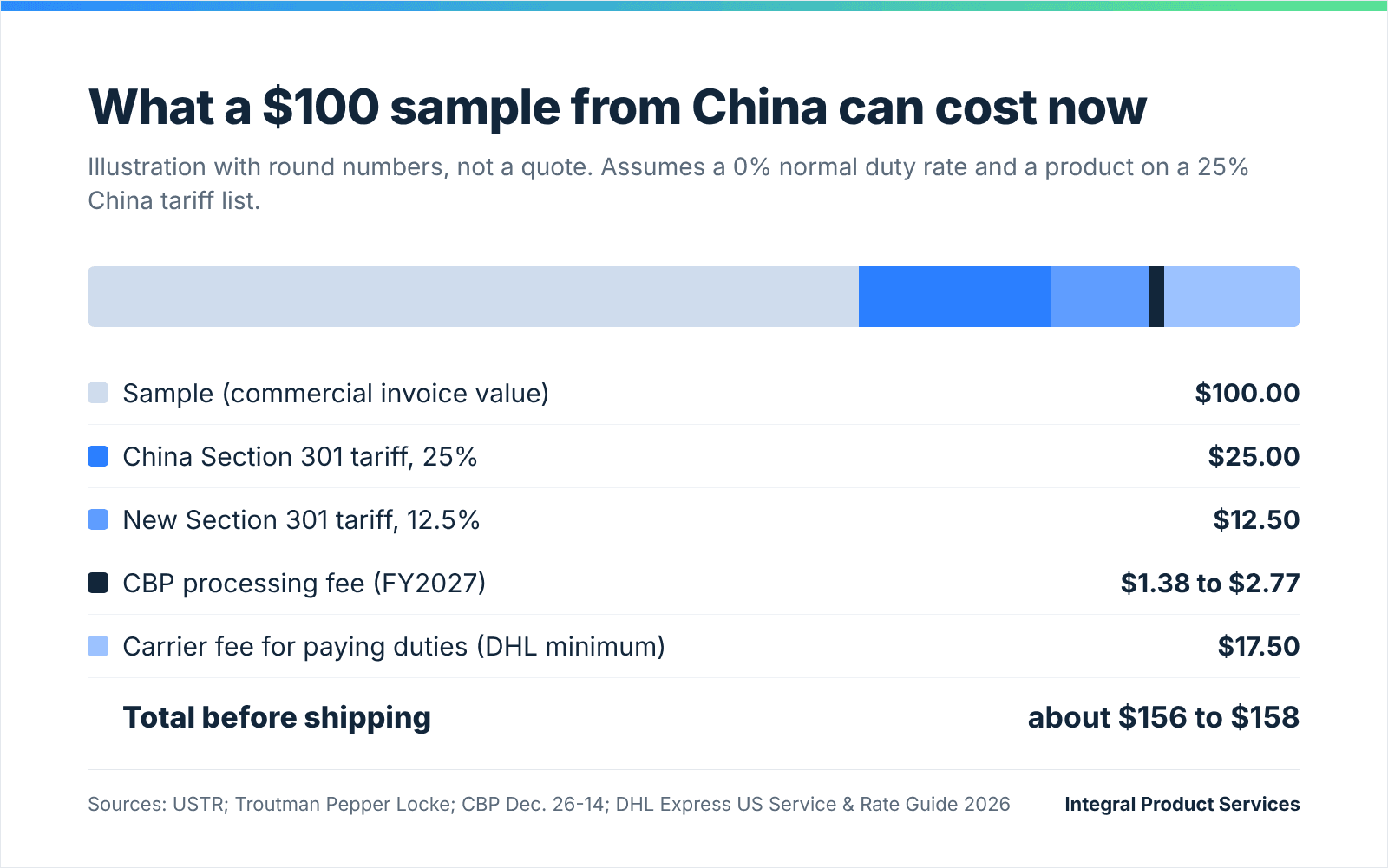
Free to use with credit: you may share this graphic as long as you link back to this article.
- China Section 301 tariff (25%): $25.00
- New Section 301 tariff (12.5%): $12.50
- CBP processing fee: about $1.38 to $2.77 for the 2027 fiscal year, which began October 1, 2026. Shipments cleared through an express courier facility pay a $1.38 per-waybill fee; an electronically filed informal entry pays $2.77.
- Carrier fee for paying duties on your behalf: for example, DHL’s 2026 US Service and Rate Guide lists a Duty Tax Processing charge of 2.5% of the duties and fees it pays, with a minimum of $17.50.
That is roughly $56 to $58 on top of the $100 sample, before shipping, and before other carrier fees. On a lower-duty product the gap is smaller; on a product with a high normal duty rate it is larger. Either way, budget for it in each sample round.
Do the duty-free “sample” rules help?
Probably not. The US tariff schedule does have duty-free provisions for samples, but they are narrow. One covers samples worth no more than $1 each or marked so they cannot be sold, and it applies only to samples “used in the United States only for soliciting orders” for foreign products. Another allows samples “solely for use in taking orders” to enter under a bond. A prototype you are testing and refining is usually neither, so plan on paying.
What you should not do is ask a supplier to write a lower value on the invoice. Federal rules require the invoice to show the price paid (or, for a free sample, its value), and penalties can reach twice the lost duties for negligence and the goods’ domestic value for fraud. It is not worth the risk for a sample.
How can you spend less on samples?
The biggest savings come from habits, not loopholes:
- Settle the design digitally first. Every physical round you replace with a CAD model or renderings is a round of shipping, duty and fees you do not pay. Our article on patenting without a prototype explains what the patent office requires and what a prototype is still good for.
- Consolidate. One box with several sample variants pays one entry fee and one set of carrier charges.
- Ask for a delivered-duty-paid quote. Some suppliers will quote a price that includes duties and delivery, so you know the full cost before you order. Read what it includes.
- Prototype early rounds locally. A 3D print or a local maker can answer form-and-fit questions without an international shipment.
- Put samples into your landed cost. Duties on samples are a preview of the duties on production. Our guide to landed cost explains what goes into the full per-unit number.
The honest limit here: none of this makes tariffs go away, and rates may change again before your production order. Treat any duty estimate as a range, and re-check it when you place the order. Getting a reliable number usually takes a product classification, a supplier quote and a freight quote, which is why manufacturing cost work is its own specialty.
Planning your first production run?
At Integral Product Services, we help inventors get a manufacturing cost analysis through vetted manufacturers before they commit to tooling or inventory. If you hold a patent or a pending application, you can request a free, no-obligation Patent Review or call us at 813-413-1863.
Not ready for a call? The same page offers our free guide, After You File.
This article is general information, not legal, customs or tax advice. Duty rates depend on the exact product classification and change often. Check current rates with a licensed customs broker before you import.
Sources
- CBP, Notice of Implementation of the President’s Executive Order 14324, September 2, 2025
- Federal Register, CBP interim final rule on the de minimis suspension for non-postal shipments, June 24, 2026
- Federal Register, Indefinite Suspension of the De Minimis Exemption for Mail Shipments and New Postal Informal Entry, June 24, 2026
- USTR, Continuation of Section 301 actions on China, October 7, 2026
- Troutman Pepper Locke, Forced Labor, Meet Section 301: New Tariffs Target 60 of America’s Biggest Trading Partners, July 24, 2026
- Sandler, Travis & Rosenberg, Section 301 Tariffs on China
- Exfreight, Trade Court Questions Legal Basis of Section 301 Forced-Labor Tariffs, October 1, 2026
- CBP, FY2027 user fee update (CBP Dec. 26-14), July 31, 2026
- DHL Express, US Service and Rate Guide 2026
- AP via AgriNews, US and China release nonsensitive product lists for tariff cuts after Trump-Xi meeting, October 11, 2026
- USITC, Harmonized Tariff Schedule, headings 9811.00.60 and 9813.00.20
- CBP, Traveling with Samples
- eCFR, 19 CFR 141.86, Contents of invoices and 19 CFR 162.73, Penalties
Have a patent or patent pending? Let’s find your next step.
Get a free Patent Review from a Product Launch Specialist. No cost, no obligation, prototype not required.