Part of our guide Licensing Your Invention, which puts every article on this topic in the order you will need them.
Key takeaways
- Licensing means a company pays you, usually a royalty on its sales, for the right to make and sell your invention, while you keep ownership of the patent.
- Companies license products they can see working, protect, build and sell. A patent covers only one of those four, so the rest has to be shown with evidence.
- Many companies only accept outside ideas on their own non-confidential terms, which is why it pays to file a patent application before you submit anything.
- Licensing can take months or years, much outreach gets no reply, and many deals earn modest royalties. Go in with real evidence and realistic expectations.
You have a patent, or an application on file, and you would rather not build a company around your invention. Licensing sounds like the ideal answer: a business that already makes and sells products in your category does the manufacturing, the marketing and the selling, and you collect a share of every sale.
That is how it works when it works. The hard part is getting there. Companies receive far more outside ideas than they can use, they protect themselves carefully when they look at one, and the deal terms have more moving parts than the royalty rate.
This guide walks through the whole path in plain language: what a license is, what companies need to see, how to approach them, what the contract usually covers, and where it tends to go wrong. Many sections link to a deeper article if you want more detail.
What does it mean to license an invention?
A license is permission to use your patent rights on agreed terms. You keep ownership. The USPTO’s examination manual (MPEP 301) puts the distinction simply: an assignment transfers ownership of the patent, while “a license is not an assignment of the patent.” A license hands over a bundle of rights that is less than full ownership.
Those rights can be limited in three main ways, according to the same USPTO guidance: by time, by geographical area and by field of use (for example, a design licensed only for kitchen products). The World Intellectual Property Organization’s licensing guide adds the three common levels of exclusivity:
- Exclusive license: only the licensee may use the invention in the territory, sometimes not even you.
- Sole license: you and the licensee can use it, but no one else.
- Non-exclusive license: you can license the same invention to several companies.
Many consumer-product companies want exclusivity in their market. That is reasonable, since they are taking on the cost of tooling, inventory and marketing, but it means the choice of partner matters a great deal.
Is licensing the right road for your invention?
Licensing trades control and profit per unit for lower cost and lower risk. The company carries the business. You give up most of the say over design, price and marketing, and you earn a small percentage of each sale rather than the full margin.
It tends to fit when a company already sells to the exact buyer your product serves, when manufacturing or advertising costs would be hard for you to carry, or when you simply do not want to run a product business. It fits less well when you have a passionate niche audience you can reach cheaply yourself. Our License It or Build It? framework walks through that choice with five questions.
What do companies need to see before they license a product?
Companies are not judging how clever the idea is. They are judging how much risk they take on. In our article on what manufacturers look for, we break it into four checks:
- Proof of function: does it work?
- Protectable IP: a granted patent or a pending application.
- Buildable design: can their existing factories and suppliers make it at a sensible cost?
- Market fit: will it sell through the channels and price points they already use?
Your patent covers the second check. The others have to be shown. Renderings, animation and a CAD model can often answer the first. A product summary and a manufacturing cost estimate answer the third. Early demand signals, such as signups, saves and pre-orders, speak to the fourth, which is the one a company has the hardest time judging on its own.
How to license an invention, step by step
There is no single official process, but the path most inventors follow looks like this.
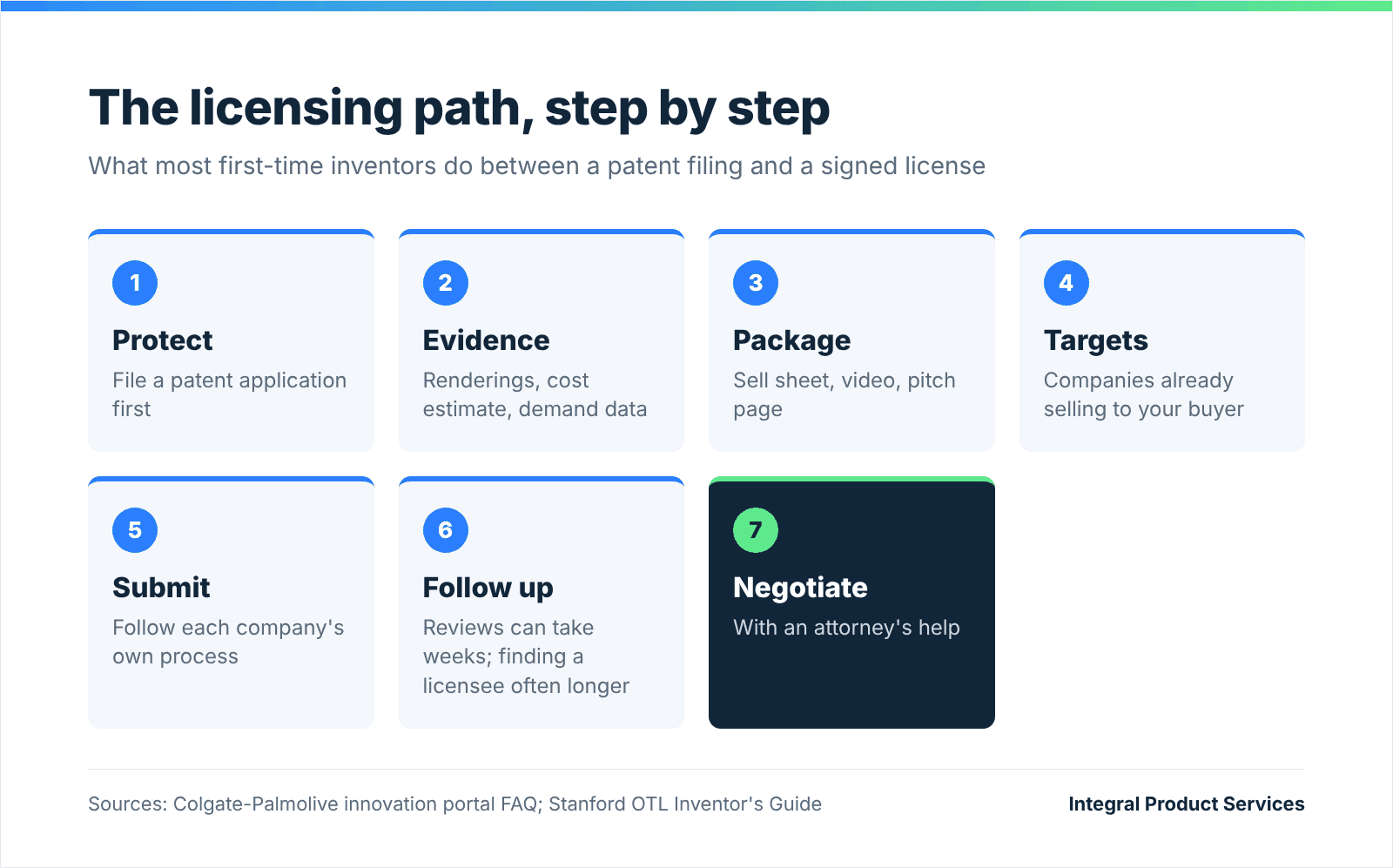
Free to use with credit: you may share this graphic as long as you link back to this article.
- Protect what you can first. File a patent application before you show the invention to anyone outside a confidential relationship. If you have not built a prototype yet, our guide on patenting without a prototype explains what the patent office actually requires. A granted patent is an asset, but it is not proof that anyone will buy.
- Gather evidence. Photorealistic renderings or photos, a short video showing the problem and your solution, a realistic landed cost estimate, and whatever market data you can collect.
- Build a licensing package. A one-page sell sheet focused on the benefit to the end customer, not on patent claims; a short video; and a simple web page a decision-maker can open from an email.
- Build a target list. Look for companies that already sell similar products in the same store aisle or online category, at a similar price. A company that does not sell to your customer today is unlikely to start because of one product.
- Submit the way each company asks. Many companies publish an idea-submission policy or portal. Follow it exactly, even when it is less comfortable than you would like (see the next section).
- Follow up, then wait. Colgate-Palmolive’s innovation portal, for example, says submitters are contacted within about five working days and that its review “may take several weeks.” Finding the right licensee often takes much longer: Stanford’s technology licensing office notes it can take months, and sometimes years, to locate one.
- Negotiate with professional help. When a company is interested, have a patent or licensing attorney review the term sheet before you agree to anything.
How do companies handle outside idea submissions?
This catches many first-time inventors off guard. Companies see a steady stream of outside ideas, and they need protection from claims that they copied something they were already developing. So many of them will not sign an inventor’s non-disclosure agreement (NDA) and will only look at material on their own terms.
Here is how three companies describe it in their published policies:
- Logitech says it “will not sign a Non-Disclosure or Confidentiality Agreement” about a submission, and that submissions are treated as non-confidential.
- Colgate-Palmolive’s innovation portal accepts “only non-confidential information” and says the ideal submission is protected by granted or applied-for patents. A separate confidentiality agreement may follow if Colgate wants to go further.
- Streamlight will not review an idea unless a non-provisional utility or design patent has issued (a provisional application does not count), or the submitter signs an agreement disclaiming any duty of confidentiality.
The practical lessons are the same everywhere. File your patent application before you submit. Share only what you would be comfortable seeing in public. Read the submission agreement closely, because it may limit your claims against the company, and ask a professional if any part is unclear.
What goes into a licensing agreement?
The royalty rate gets the attention, but it is only one of several terms that decide what a deal is worth. A sample exclusive license agreement from the University of Kansas’s technology commercialization office shows the common pieces. University deals differ from consumer-product deals, so treat this as a map of the terms, not a template:
- Upfront fee: a one-time payment when the license is signed.
- Running royalty: a percentage of the licensee’s net sales, typically paid quarterly. Our article on royalty rates covers typical ranges by industry and what “net sales” leaves out.
- Minimum annual royalty: a floor the company pays even if sales are slow. This gives the company a reason not to shelve your product.
- Patent costs: whether the licensee reimburses the cost of filing and maintaining the patent.
- Sublicensing: what you receive if the licensee passes rights to another company.
- Audit rights: your right to check the royalty reports.
- Term and termination: how long the license lasts, and what ends it. The Kansas sample lets the university end the license if payments or reports stop, or if the company is no longer actively commercializing the product.
- Performance milestones: agreed development steps the company must reach, sometimes with payments attached.
The last two points matter more than most inventors expect. An exclusive license with no minimums and no milestones can tie up your invention for years with nothing to show for it.
How likely is licensing to work?
Honestly, the odds are not in any inventor’s favor, and it helps to know that going in.
One large study surveyed inventors on about 1,900 US patents that had also been filed in Japan and Europe, covering priority years 2000 to 2003. Researchers Sadao Nagaoka and John Walsh found that about 14% of those US patents were licensed. These were patents important enough to file in three patent offices, mostly from inventors at large companies, so a first-time inventor’s odds are likely lower, not higher. Stanford University’s technology licensing office says plainly in its inventor guide that “most licenses do not yield substantial royalties.”
In practice, much outreach gets no reply. A no often reflects a company’s product roadmap, budget cycle or category trends rather than the quality of the idea. What preparation does is keep a good product from being dismissed for avoidable reasons: no evidence it works, no cost figure, no sign anyone wants it. It improves your chances. It does not guarantee a deal, and anyone who promises one is overselling.
What mistakes cost inventors a licensing deal?
Common avoidable problems fall into a few patterns:
- Pitching the patent instead of the product. Decision-makers want to know who buys it, why, and at what price. Claim language belongs in the follow-up, not the first page.
- Pitching the wrong companies. A great product sent to a company outside its category usually gets no reply. Fit with what the company already sells matters more than the size of the company.
- Arriving without a cost figure. If a company cannot see how the product fits its margins, it has to do that work itself, and often will not.
- Sharing too much, too early. Detailed drawings and confidential know-how belong after a patent application is on file and, where possible, under an agreement both sides have signed.
- Accepting exclusivity with no minimums. Exclusive rights without minimum royalties or milestones can leave your invention parked on a shelf.
Each of these is fixable before you send the first email, which is the best time to fix them.
Where can first-time inventors get free help?
- SCORE, an SBA resource partner, offers free business mentoring from volunteer mentors, which can help with the business side of a licensing decision.
- The USPTO Inventors Assistance Center answers general questions about patent examining policy and procedures, though it cannot give legal advice.
- The USPTO’s inventor programs cover commercialization topics, including a session on licensing a product or concept held in May 2026 with the Licensing Executives Society’s Silicon Valley chapter. Check the USPTO events page for upcoming sessions.
- The USPTO Patent Pro Bono Program connects eligible inventors with volunteer attorneys for the patent application itself.
Doing licensing well draws on several specialties at once: design and renderings, cost estimates, market testing, the pitch materials and the outreach. Coordinating them is its own job, which is why many inventors bring in help for parts of it.
Questions inventors ask about licensing
Do I need a patent to license an invention?
Not always legally, but practically, yes in most cases. Many companies prefer, and some require, a granted patent or a pending application before they will review an idea, and an application on file protects your priority date before you start sharing.
Should I ask a company to sign an NDA?
You can ask, but many companies will decline and point you to their own submission terms. That is normal, not a red flag. File first and share only non-confidential material.
How much money will I make?
It depends on the royalty rate, the net sales it applies to, and how many units sell. Rates vary widely by industry and by deal. Our royalty rates article works through the math.
Can I license my invention and still sell it myself?
Only if the license allows it. An exclusive license usually rules out selling the same product in the same market yourself. A non-exclusive license, or one limited by territory or field of use, can leave room.
Thinking about licensing your invention?
At Integral Product Services, we help inventors prepare for licensing conversations with renderings, a manufacturing cost analysis, market evidence and a licensing-ready sell sheet and pitch. If you hold a patent or a pending application, you can request a free, no-obligation Patent Review or call us at 813-413-1863.
Not ready for a call? The same page offers our free guide, After You File.
This article is general information, not legal, tax or financial advice. Licensing agreements and submission terms vary. Talk to a patent or licensing attorney before you sign anything or share confidential details.
Sources
- USPTO, MPEP 301, Ownership/Assignability of Patents and Applications
- WIPO and International Trade Centre, Exchanging Value: Negotiating Technology Licensing Agreements
- University of Kansas Center for Technology Commercialization, Sample Exclusive License Agreement (updated 2023)
- Stanford Office of Technology Licensing, Inventor’s Guide
- Colgate-Palmolive, Open Innovation Portal FAQ
- Logitech, Unsolicited Submissions Policy
- Streamlight, Policy Regarding Inventor Submissions
- Nagaoka and Walsh, Commercialization and Other Uses of Patents in Japan and the US, RIETI Discussion Paper 09-E-011, 2009
- SBA, SCORE Business Mentoring
- USPTO, Successful Inventing 2026: Licensing Your Product or Concept
- USPTO, Patent Pro Bono Program: Inventors
Have a patent or patent pending? Let’s find your next step.
Get a free Patent Review from a Product Launch Specialist. No cost, no obligation, prototype not required.