Key Takeaways
- Published 2026 benchmarks put consumer goods royalties at roughly 4% to 5%, with most industries falling somewhere between 3% and 12%.
- Royalties are normally a percentage of the licensee’s net sales, which is closer to the wholesale price than the price on the shelf.
- The rate is only one term. Advances, minimum guarantees, exclusivity, and what gets deducted from “net sales” can matter as much.
- Rates go up when the licensee’s risk goes down: strong patent, product close to market, and evidence of demand.
Licensing appeals to inventors for good reasons. Someone else pays for tooling, inventory, sales staff, and shipping. You keep your day job and receive a check each quarter.
The trade-off is the size of that check. A royalty is a small slice of a large pie, and understanding the slice helps you judge whether a deal is fair and whether licensing is the right road at all.
What Are Typical Royalty Rates in 2026?
In January 2026 the intellectual property firm Stanzione & Associates published average patent royalty ranges by industry:
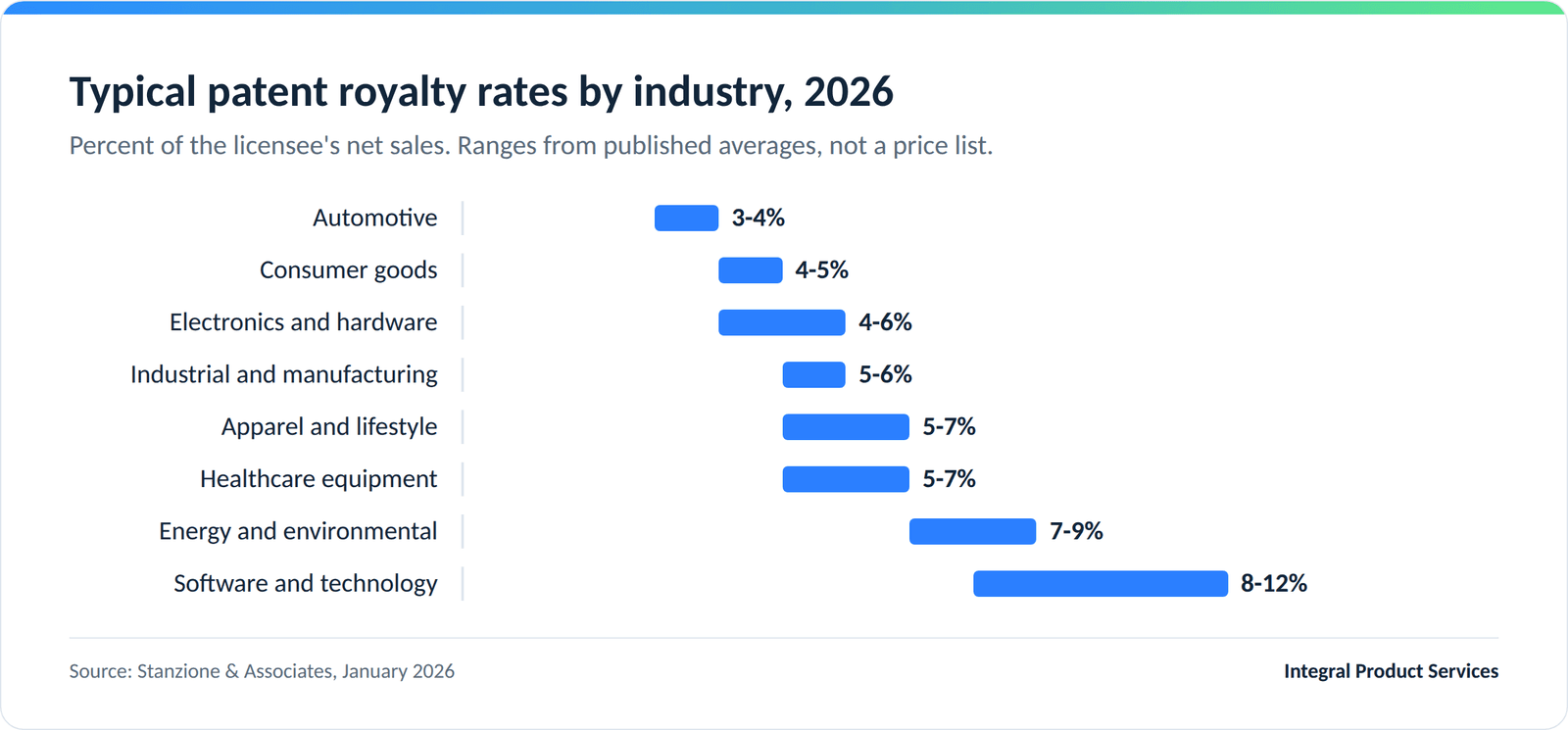
- Consumer goods: 4% to 5%
- Electronics and hardware: 4% to 6%
- Industrial and manufacturing: 5% to 6%
- Apparel and lifestyle: 5% to 7%
- Healthcare equipment: 5% to 7%
- Software and technology: 8% to 12%
The legal publisher Nolo gives a broader rule of thumb of 2% to 10% of net revenues. Most independent inventors with a physical consumer product should expect to be discussing mid-single digits.
These are averages from published deals and surveys, not a price list. Any individual agreement can land outside them.
A Percentage of What?
This is the question that catches people out. A 5% royalty is almost never 5% of the retail price.
Royalties are usually calculated on the licensee’s net sales: what the company actually receives from its customers, who are often retailers and distributors paying wholesale. The legal resource UpCounsel notes that agreements must also spell out which deductions apply, such as returns, credits, taxes, shipping, and rebates, and warns that “the broader the deductions, the smaller the royalty base may become.”
An illustration with round numbers, not a forecast: imagine a product that retails for $40 and wholesales for $20. A 5% royalty on net sales pays about $1 per unit. At 10,000 units a year, that is around $10,000. At 100,000 units, around $100,000.
Two things follow from that. Volume is everything in licensing, which is why the size and reach of the licensee matters more than squeezing out an extra half point. And the definition of “net sales” in your contract deserves as much attention as the headline rate.
The Other Terms That Matter
A licensing agreement is more than a percentage. UpCounsel describes several payment types that are commonly combined:
- Upfront fee or advance. Money paid at signing, sometimes credited against future royalties.
- Running royalties. The ongoing percentage on sales.
- Milestone payments. Triggered by events like product launch or hitting a sales threshold.
- Minimum guarantees. A floor the licensee must pay each year whether or not sales materialize.
Minimum guarantees are worth understanding. Without one, a company could license your patent, put it on a shelf, and owe you nothing. With one, they have a reason either to sell the product or to give the rights back.
Exclusivity also moves the numbers. An exclusive license commands a higher rate because, as UpCounsel puts it, “the licensor gives up the ability to license others.” A non-exclusive license pays less per deal but leaves you free to sign several.
What Pushes a Rate Up?
Both Stanzione and UpCounsel list similar factors, and they share a theme. Every one of them reduces the licensee’s risk.
- Patent strength and scope. Broad, well-drafted claims are worth more than narrow ones that are easy to design around.
- Commercial readiness. Stanzione notes that technologies closer to market adoption “reduce licensee uncertainty.” A product with finished design files and a manufacturing cost estimate is closer than a sketch.
- Market demand. Evidence that consumers want the product supports a higher rate.
- Few alternatives. If competitors can solve the same problem another way, rates fall.
- Remaining patent life. More years of protection means more years of exclusive sales.
You cannot change your patent’s claims at this point. You can change how ready and how proven the product looks. That is where an inventor has the most room to improve their position before a negotiation.
Licensing vs. Selling It Yourself
Nolo sums up the trade plainly. With licensing, “the licensee assumes all the business costs and risks, from manufacturing to marketing.” In exchange you accept much lower profit per unit and give up control over how the product is made and sold.
Selling it yourself reverses that: higher margin per unit, full control, and all the cost, work, and risk.
Neither is better in general. The right answer depends on how much capital and time you have, how much risk you can carry, and what the market tells you about demand and price.
A Sober Note on the Odds
Knowing the rates does not mean a deal is waiting. Nolo cites an older survey in which only about 13% of inventors who tried to license their invention succeeded. The figure is dated, but it is a fair reminder that most approaches to companies end in silence or a polite no.
That is an argument for preparation rather than against trying. It is also a reason to be careful with anyone who promises you a licensing deal. No one can.
Thinking About Licensing Your Product?
At Integral Product Services, we help inventors prepare the materials and gather the market evidence that make a licensing conversation more credible. To talk about your product, reply to our email or visit our contact page.
This article is general information, not legal or financial advice. Have a qualified attorney review any licensing agreement before you sign.