Part of our guide Test Before You Build, which puts every article on this topic in the order you will need them.
Key takeaways
- Product market validation means collecting evidence that real buyers want your product, based on what they do rather than what they say, before you pay for tooling, inventory or a full patent.
- Opinions are weak evidence: a review of 60 years of research by Vicki Morwitz of NYU’s Stern School of Business found that purchase intentions “predict future sales, but do so imperfectly.”
- The five market validation questions are who has the problem and how badly, what they use now, what they would pay, how you would reach them, and what evidence would change your mind.
- Each question can be tested cheaply, with conversations about past behavior, a competitor scan, a commitment at a stated price and a stop rule written in advance, but none of it proves sales at scale.
Many inventors meet the big spending decisions in the same order. First the idea, then a sketch, maybe a rough prototype, and then a quote for a full patent application, a production mold or a first inventory order. Each step costs more than the last, and each is harder to undo. Product market validation is the work of finding out, before those checks are written, whether enough people want the product badly enough to pay for it.
The stakes are real. In a March 2026 analysis of 431 venture-backed startups that shut down since 2023, CB Insights could identify failure reasons for 385, and 43% of those cited poor product-market fit. Only running out of capital, at 70%, was more common, and a company could have more than one reason. CB Insights adds that running out of money is “almost always the final cause of death, not the root problem.” Those were funded companies, not solo inventors, but the pattern carries over: an empty bank account is often the last symptom of a market that never showed up.
Below are the five questions we suggest every inventor answer first, each with a cheap way to get real evidence instead of compliments.
What is product market validation, and why don’t opinions count?
Validation is not asking people whether they like your idea. Friends and family want to be supportive, and strangers want to be polite. Rob Fitzpatrick’s book on customer conversations, The Mom Test, puts the problem in its subtitle: “How to talk to customers & learn if your business is a good idea when everyone is lying to you.”
Even sincere answers about the future are unreliable. A review of 60 years of research by Vicki Morwitz of NYU’s Stern School of Business puts it plainly: purchase intentions “predict future sales, but do so imperfectly.” People mean what they say when they say it, and then real life, real prices and real alternatives get in the way.
So the rule we use is simple. Evidence is something a person did or gave up: time, money, an email address, a homemade workaround, a product they already bought. Everything else is opinion. Each of the five market validation questions below is built to collect the first kind.
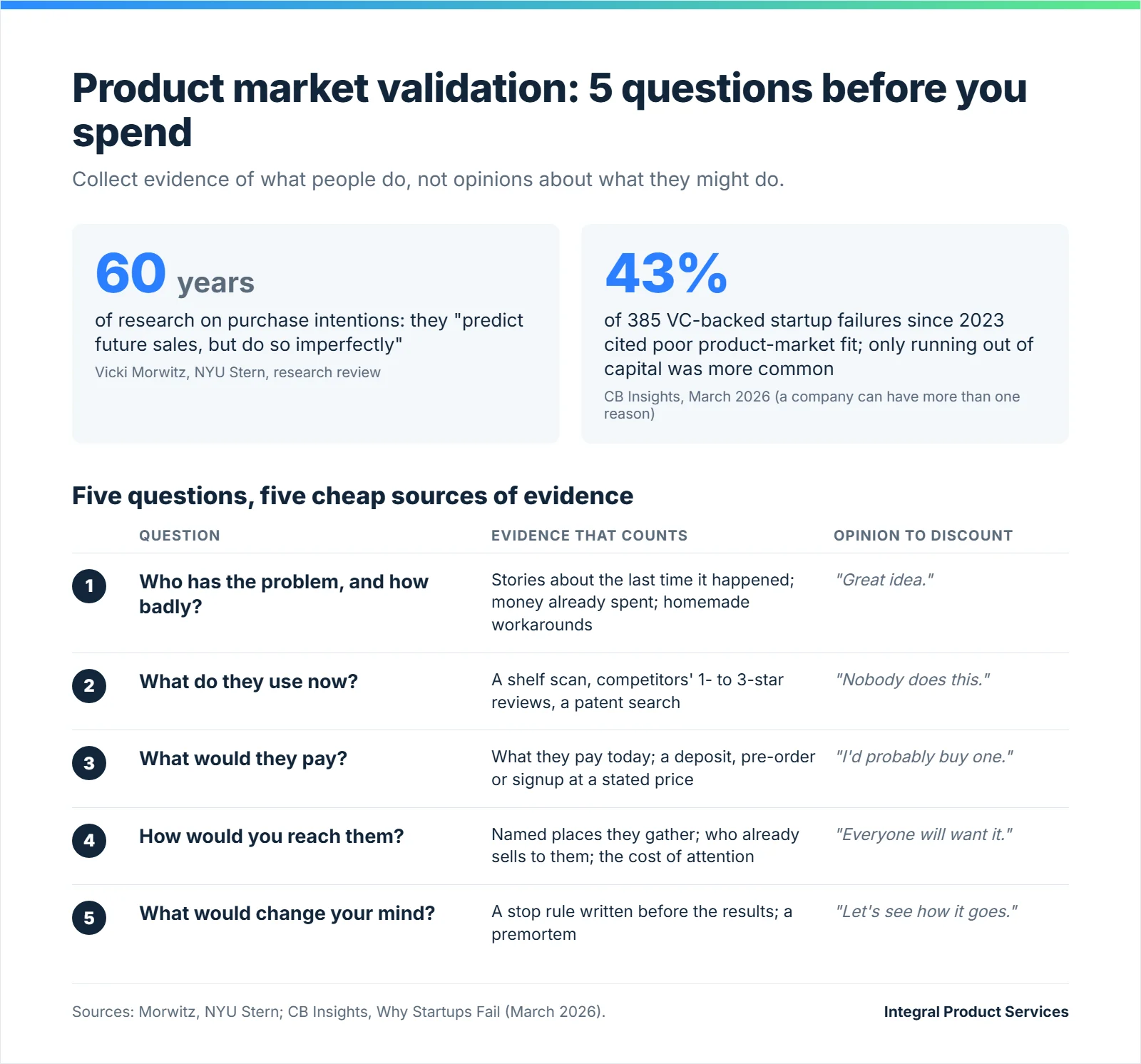
Free to use with credit: you may share this graphic as long as you link back to this article.
- Who has the problem, and how badly?
Start with the problem, not the product. Who has it, how often does it happen, and what does it cost them in time, money, frustration or risk? A problem that comes up once a year is a thin base for a product, however clever the fix.
Cheap ways to get evidence:
- Conversations about the last time it happened. Ask 10 to 15 people who have the problem to walk you through the most recent time it came up. What did they do? What did it cost? Did they look for a fix? Hold your product back until the end, if you mention it at all.
- Public complaints. Forums, Reddit threads, product reviews and comment sections where people describe the problem in their own words. Save the exact phrases they use. They often become your best marketing copy later.
- Search interest. Google Trends is free and shows whether interest in a problem is growing, flat or seasonal. Read it with care. Google says its scores are scaled from 0 to 100 relative to all searches in that place and time, that low-volume terms can show up as zero, and that Trends “is not a scientific poll.”
The strongest sign is a person who has already spent money or built a workaround. That person has shown you, not told you, that the problem hurts.
- What do they use now?
“Nobody else does this” is almost never true, and when it is, it is not always good news. People with a real problem are already doing something about it: buying a competing product, adapting a tool meant for something else, paying someone to handle it, or simply putting up with it. All of these are your competition, and the last one is often the hardest to beat.
Cheap ways to get evidence:
- Shop the shelf. Search Amazon, big-box retailers and specialty stores for anything that solves the same problem. Write down what each costs, how it is sold and how it describes itself.
- Read the one- to three-star reviews of the closest competitors. They show what buyers wish were different, and whether your improvement is something they actually ask for.
- Search patents and published applications. The USPTO’s Patent Public Search tool covers U.S. patents and published applications. One thing to know: the USPTO says that, starting November 7, 2026, Patent Public Search requires users to sign in with a USPTO account, so set one up before you start. Treat this as a business check for how crowded the space is, not a legal opinion on whether you can patent or sell your product.
The useful output is one sentence: “People solve this today with X, and they put up with Y.” If your product doesn’t clearly fix Y, the effort of switching may beat you.
- What would they pay?
Price is where opinions are least reliable. Asking “Would you buy this for $40?” invites a polite yes that costs the speaker nothing. Better evidence comes from what people already pay and what they will commit to now.
Cheap ways to get evidence:
- The current spend. What do they pay for the product or workaround they use today, and how often do they replace it? That anchors your price in a real number instead of a hopeful one.
- A commitment at a stated price. A deposit, a pre-order or even an email signup on a page that shows the price tells you more than any survey. We explain what those numbers can and cannot tell you in Pre-Orders as Market Research: What the Numbers Can and Cannot Tell You.
- The floor under the price. The price has to cover manufacturing, shipping, duties, returns and marketing, with margin left over. If the price people will pay can’t carry those costs, that is a finding worth having early. How to Price a New Product So Every Sale Still Pays walks through that math channel by channel.
- How would you reach them?
A product people want can still fail if you can’t get in front of them at a cost that leaves a profit. Inventors often push this question to later because it feels like a marketing detail. It isn’t one. The way you reach buyers shapes the price, the packaging and sometimes the product itself.
Cheap ways to get evidence:
- Name the places. List the specific websites, online communities, stores, catalogs, trade groups and creators your buyer already pays attention to. If you can’t name three, that is a gap to close before you build.
- Look at who already sells to them. Retailers and brands that already reach your buyer are possible channels, partners or licensees, and their presence tells you the audience can be reached.
- Price the attention. Paid ads are the default answer, and they are rarely cheap for a new product with no reviews or brand recognition. We look at why in Cheap Traffic Is Gone. What Rising Ad Costs Mean for a Brand-New Product.
The answer also depends on your route to market. Selling direct means finding buyers one at a time. Licensing means convincing a small number of companies that already reach those buyers. Either way, you want a believable answer before you spend on tooling.
- What evidence would change your mind?
This is the question many inventors skip, and it may be the most valuable. Before you gather any evidence, write down which results would make you stop, change the product or change the plan. Without that, almost any result can be read as encouraging.
Cheap tools:
- A written stop rule. For example (an illustration, not a benchmark): “If fewer than 3 of the 15 people I interview have spent money on this problem in the past year, I will rethink the design before paying for a mold.” Choose your own numbers, but choose them before you see the results.
- A premortem. Gary Klein described this in Harvard Business Review: team members “assume that the project they are planning has just failed” and then come up with plausible reasons why. Do it alone or with a blunt friend. Each reason you list is a risky assumption, and each one points to something you can test.
- A reader with no stake. Show your evidence to someone who doesn’t care whether you go ahead, and ask what they would conclude.
The aim is not to talk yourself out of the idea. It is to make your next spending decision on evidence you would accept if someone else brought it to you.
What can these questions not tell you?
Here is the honest limit. Answering these questions well lowers your risk, but it does not prove the product will sell. Your samples are small, and the people who answer you are the ones willing to talk, which is not the same as a random slice of the market. Early interest can also fade once the novelty wears off.
These questions also can’t tell you what a factory will charge, whether your design can be made at the cost you need, or whether your patent claims cover what you think they cover. Those need quotes from manufacturers and advice from a registered patent attorney or agent. Many inventors use a provisional application to secure a filing date while they gather this kind of evidence. We cover the trade-offs in The Provisional Patent Strategy: How to Protect Your Invention and Test the Market for Cheap.
Finally, getting good answers usually draws on several skills at once: renderings that show the product clearly, a page that can take signups or deposits, a way to reach the right people, and analytics to read what happened. Coordinating those pieces is a job of its own.
Ready to test your idea?
At Integral Product Services, we help inventors test the market before they spend on inventory, with renderings, a website that can take pre-orders and collect emails, social campaigns and the analytics to read the results. If you hold a patent or a pending application, you can request a free, no-obligation Patent Review or call us at 813-413-1863.
Not ready for a call? The same page offers our free guide, After You File.
This article is general business information, not legal advice. For questions about patentability, patent searches or filing strategy, talk to a registered patent attorney or agent.
Sources
- CB Insights, Why Startups Fail: Top 9 Reasons, March 5, 2026
- Vicki Morwitz, Consumers’ Purchase Intentions and Their Behavior, now publishers, accessed October 16, 2026
- Rob Fitzpatrick, The Mom Test, book website, accessed October 16, 2026
- Google Trends Help, FAQ about Google Trends data, accessed October 16, 2026
- USPTO, Patent Public Search, page updated September 28, 2026
- Harvard Business Review, Gary Klein, Performing a Project Premortem, September 2007
Have a patent or patent pending? Let’s find your next step.
Get a free Patent Review from a Product Launch Specialist. No cost, no obligation, prototype not required.