Part of our guide After the Patent, which puts every article on this topic in the order you will need them.
Key takeaways
- A provisional patent application gives you a US filing date and the right to say “patent pending,” but the USPTO never examines it, it cannot become a patent on its own, and its 12-month life cannot be extended.
- At the USPTO’s current fees, a provisional costs $325 to file for a large entity, $130 for a small entity and $65 for a micro entity, before any attorney or agent fees.
- A provisional only protects what it describes, so a thin filing, or a design that changes a lot after filing, can cost you the early date for the features that matter.
- Testing in public is safer after you file, but the US one-year grace period for your own disclosures does not exist in the European patent system, and foreign filings that claim your provisional’s date must be made within the 12-month Paris Convention priority period.
Many inventors file a provisional patent application and then wait. Eleven months later, the deadline for the full application arrives, and they still don’t know whether anyone will buy the product, what it will cost to make, or whether the design they described is the one they’ll sell.
A better provisional patent application strategy treats those 12 months as a project plan, not a waiting room. The filing date gives you a window to build, show and price the product. If you use it on purpose, you reach the deadline with evidence instead of hope. You can then decide whether the bigger spend on a nonprovisional application is worth it.
This article covers the business side of that plan. It is not legal advice, and the drafting decisions belong with a registered patent attorney or agent.
What a provisional patent application is, and what it is not
A provisional patent application is a lower-cost US filing that establishes an early filing date for your invention. The USPTO’s Provisional Application for Patent page sets out the rules that shape your year:
- It is never examined. In the USPTO’s words, “Provisional applications are not examined on their merits.”
- It cannot become a patent by itself. The USPTO’s Basics of a Provisional Application states that only a later-filed nonprovisional application may issue as a patent. The provisional is abandoned automatically at 12 months.
- The 12 months are fixed. “The 12-month pendency period cannot be extended.” To claim the provisional’s date, the nonprovisional must be filed within 12 months of it, according to MPEP 211. The MPEP describes a narrow petition for unintentional delay that can reach 14 months. Treat it as an emergency exit, not a plan.
- It needs a full description, not claims. A provisional does not need formal claims. It does need a written description of the invention, and the USPTO notes that even a drawing needed to understand the invention “cannot be introduced into an application after the filing date because of the prohibition against new matter.” Anything you leave out of the provisional does not get its date.
The last point is the one that catches inventors. The USPTO’s own slides on drafting a provisional say a later nonprovisional must be “adequately supported” by what you filed. They advise you to “Describe as many alternative features and embodiments as possible,” and they warn that “too much change could result in loss of provisional filing date.”
If you are still deciding whether you need a prototype before filing at all, we cover that in Can You Patent an Idea Without a Prototype? This article picks up after the filing.
What does a provisional cost to file?
According to the USPTO fee schedule (fees effective January 19, 2025, page last revised August 14, 2026), the provisional application filing fee is:
- $325 for a large entity
- $130 for a small entity
- $65 for a micro entity
A provisional longer than 100 sheets adds a size fee for each additional 50 sheets. Your entity size depends on who you are and who owns the rights. The USPTO’s small and micro entity page explains that small entity status gives a 60% discount on most fees and micro entity status gives 80%. Micro entity status also has income and prior-filing limits, so check before you certify.
For perspective at the decision point, the same schedule lists the basic filing, search and examination fees for a utility nonprovisional. Filed electronically, they come to $2,000 for a large entity, $730 for a small entity and $400 for a micro entity. Those are government fees only. Professional drafting fees, claim fees and later issue fees come on top. Fees change, so check the current schedule before you budget.
What does “patent pending” actually do?
Once your provisional is filed, you may mark the product and your marketing “patent pending.” It is useful, but it is weaker than many inventors assume. The USPTO’s Managing a patent page says the phrases “patent pending” and “patent applied for” “have no legal effect, but only inform the public that a patent application has been filed with the USPTO.” The same page adds, “Patent protection does not start until actually granted.”
So “patent pending” can signal to buyers, licensees and copycats that you took a step. It cannot stop anyone from copying you during the year. Use it accurately, too: the same USPTO page says false use of these phrases is prohibited and subject to a fine.
Can you test the market with a provisional patent?
Yes. That is the main reason to have one. You can test the market with a provisional patent on file, but the filing protects only what it describes and only from its date forward. Three rules keep testing from undercutting your rights.
Show what you filed. Public testing (a trade show booth, a crowdfunding page, a social campaign, a store listing) describes your invention to the world. Under 35 U.S.C. 102, prior art includes anything “in public use, on sale, or otherwise available to the public before the effective filing date.” If what you show is in your provisional, your filing date came first. If you show a new feature you never filed, that feature has no protected date yet.
Know the US grace period and its limits. US law gives inventors a cushion for their own disclosures. Under 35 U.S.C. 102(b)(1), “A disclosure made 1 year or less before the effective filing date of a claimed invention shall not be prior art” when it came from the inventor. The European patent system does not offer the same cushion. Under Article 54 of the European Patent Convention, the state of the art is “everything made available to the public” before filing. Article 55 excuses only evident abuse or display at an officially recognized international exhibition, within six months. WIPO’s grace period table shows how much other countries vary, from 12 months to six months to narrow exceptions. The USPTO’s provisional page puts the risk plainly: a pre-filing disclosure, “although protected in the United States, may preclude patenting in foreign countries.”
Watch the foreign clock. Under Article 4 of the Paris Convention, the priority period is “twelve months for patents and utility models.” If you might want protection outside the US, that decision runs on the same 12-month clock as your nonprovisional.
Use NDAs for private conversations with manufacturers or potential licensees. WIPO’s guide for small businesses, Inventing the Future, advises that disclosure before filing “should be made only after signing a confidentiality or non-disclosure agreement.”
A month-by-month plan for your 12 months
Here is a sample plan. Your product may need more time to build or less time to test. The point is to set the decision date first and work backward from it.
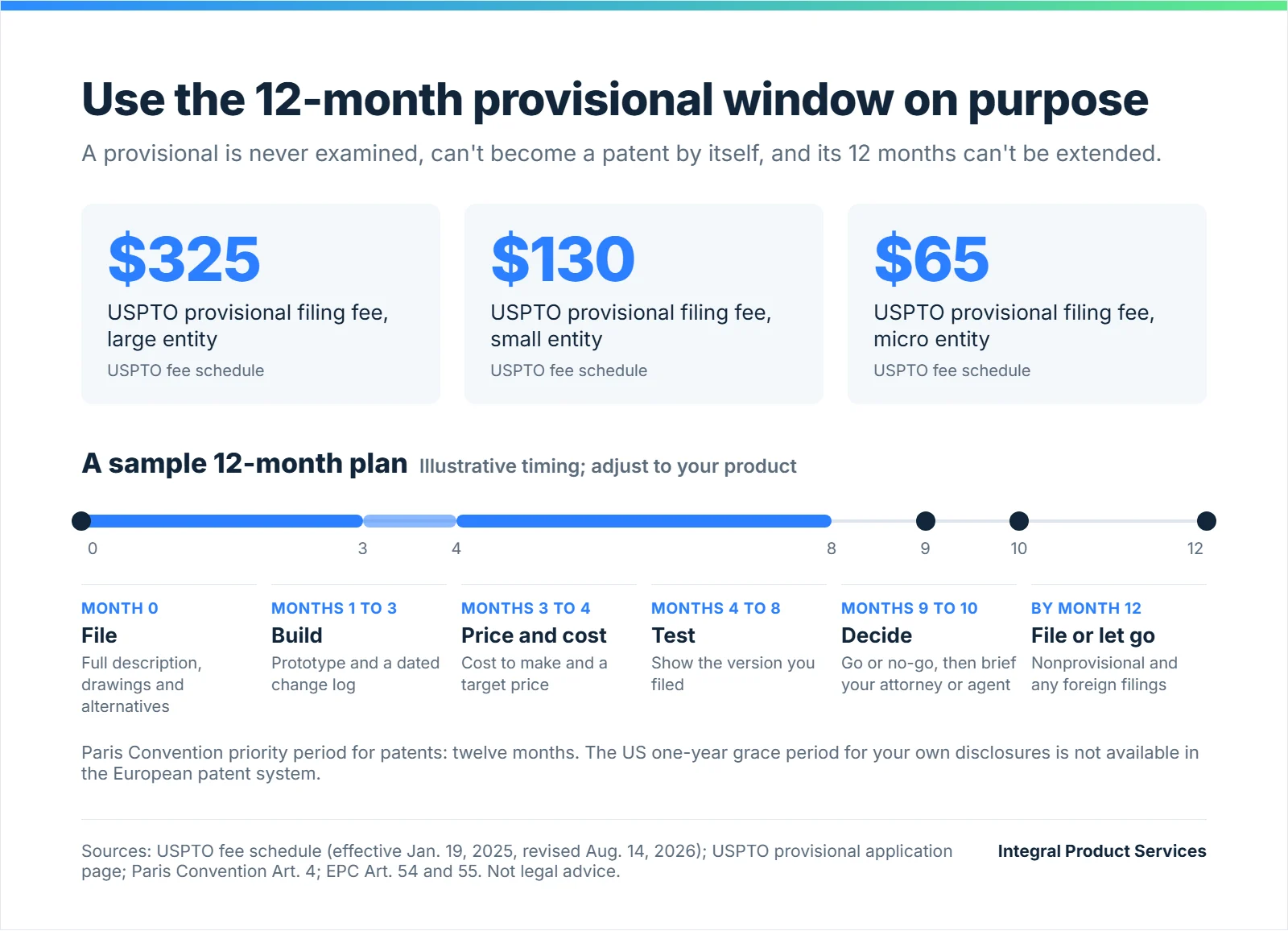
Free to use with credit: you may share this graphic as long as you link back to this article.
- Before you file (month 0). Keep the invention confidential. Work with your patent attorney or agent on a full description with drawings, variations and alternatives, so you aren’t locked into one version. Put three dates on the calendar the day you file: month 9 (decision), month 10 (attorney briefing) and month 12 (deadline).
- Months 1 to 3: build. Turn the description into a works-like prototype and, if you can, a looks-like model. Keep a dated log of every design change. If a change is significant, ask your attorney or agent before you show it in public whether it should go into a new provisional. A new provisional has its own date. It does not extend the first one.
- Months 3 to 4: price and cost. Get a rough cost-to-make estimate and a target retail price. A product that works but can’t be made at a sensible margin is a finding worth having in month 4, not month 13.
- Months 4 to 8: test. Put the version you filed in front of real buyers. Renderings and a landing page that takes emails or pre-orders, a small paid or organic social test, and conversations with retailers or potential licensees under NDA all count. We explain what those signals mean in Pre-Orders as Market Research: What the Numbers Can and Cannot Tell You and Organic Social Media as a Low-Cost Market Test.
- Month 9: decide. Compare results with the go/no-go thresholds you wrote down at the start. The choices are usually to proceed toward selling it yourself, to pursue licensing, to redesign, or to stop. License It or Build It? A Plain Framework for the Decision walks through that fork.
- Month 10: brief your attorney or agent. Bring the final design, the change log and your test findings. Decide whether to file the nonprovisional and whether to file abroad. Drafting a strong nonprovisional takes time, so don’t hand it over in week 51.
- By month 12: file or let go on purpose. If you file, your nonprovisional can claim the provisional’s date for what the provisional supports. If you stop, stop knowingly. Anything you showed publicly stays public, and once a year has passed since your own first public disclosure, the US grace period no longer covers it.
What a provisional patent application strategy cannot do
Now the honest limit. A provisional protects only what it describes, and only if a nonprovisional follows in time. It doesn’t tell you whether anyone wants the product, and “patent pending” doesn’t stop a determined copier. It is not a business plan. The year is valuable only if you use it to answer the business questions: Does it work? What does it cost to make? Will people pay enough? Who will sell it?
Market tests have limits too. A small test can be noisy, and early interest is not the same as repeat sales. Running the year well also pulls on several specialties at once: patent drafting, engineering, cost estimating, web, ads and analytics. Coordinating them is a job of its own.
Planning your 12 months?
At Integral Product Services, we help inventors test the market before they spend on inventory, with renderings, a website that can take pre-orders and collect emails, social campaigns and the analytics to read the results. If you hold a patent or a pending application, you can request a free, no-obligation Patent Review or call us at 813-413-1863.
Not ready for a call? The same page offers our free guide, After You File.
This article is general information, not legal advice. Patent rules and USPTO fees change, and foreign rules differ by country. Talk to a registered patent attorney or agent about your specific situation.
Sources
- USPTO, Provisional Application for Patent, last updated December 15, 2023, accessed October 16, 2026
- USPTO, Basics of a Provisional Application (PDF), accessed October 16, 2026
- USPTO, Drafting a Provisional Application (PDF slides, April 12, 2018, with fees updated June 2023), accessed October 16, 2026
- USPTO, USPTO fee schedule, effective January 19, 2025, last revised August 14, 2026
- USPTO, Save on fees with small and micro entity status, July 27, 2023, accessed October 16, 2026
- USPTO, Managing a patent, last updated October 20, 2025
- USPTO, MPEP 211: Claiming the Benefit of an Earlier Filing Date Under 35 U.S.C. 119(e), accessed October 16, 2026
- USPTO, MPEP 2152: Detailed Discussion of AIA 35 U.S.C. 102(a) and (b), accessed October 16, 2026
- European Patent Office, European Patent Convention, Article 54: Novelty and Article 55: Non-prejudicial disclosures, accessed October 16, 2026
- WIPO, Paris Convention for the Protection of Industrial Property, Article 4, accessed October 16, 2026
- WIPO Standing Committee on the Law of Patents, Grace Period (national laws table, status as of August 2024)
- WIPO, Inventing the Future: An Introduction to Patents for Small and Medium-sized Enterprises, 2018, reprinted with revisions 2019
Have a patent or patent pending? Let’s find your next step.
Get a free Patent Review from a Product Launch Specialist. No cost, no obligation, prototype not required.