Part of our guide After the Patent, which puts every article on this topic in the order you will need them.
Key takeaways
- Yes. The USPTO says a working model is not ordinarily required, as long as your written description and drawings explain the invention clearly enough to understand without one.
- What you cannot patent is a bare idea. The application has to describe how the invention is made and used, in enough detail that it stands on its own.
- Details you leave out at filing generally cannot be added later, so a prototype’s real value is catching design changes before you file the full application.
- A provisional application gives you 12 months of “patent pending” status to build, test and refine before the full application is due.
Most first-time inventors hear two pieces of advice that sound like they cancel each other out. One says build a prototype before you go near a patent attorney. The other says file as soon as possible, before someone else does.
Both have a point. The conflict mostly disappears once you know what the patent office requires and what a prototype is for.
Does the USPTO require a prototype to file a patent?
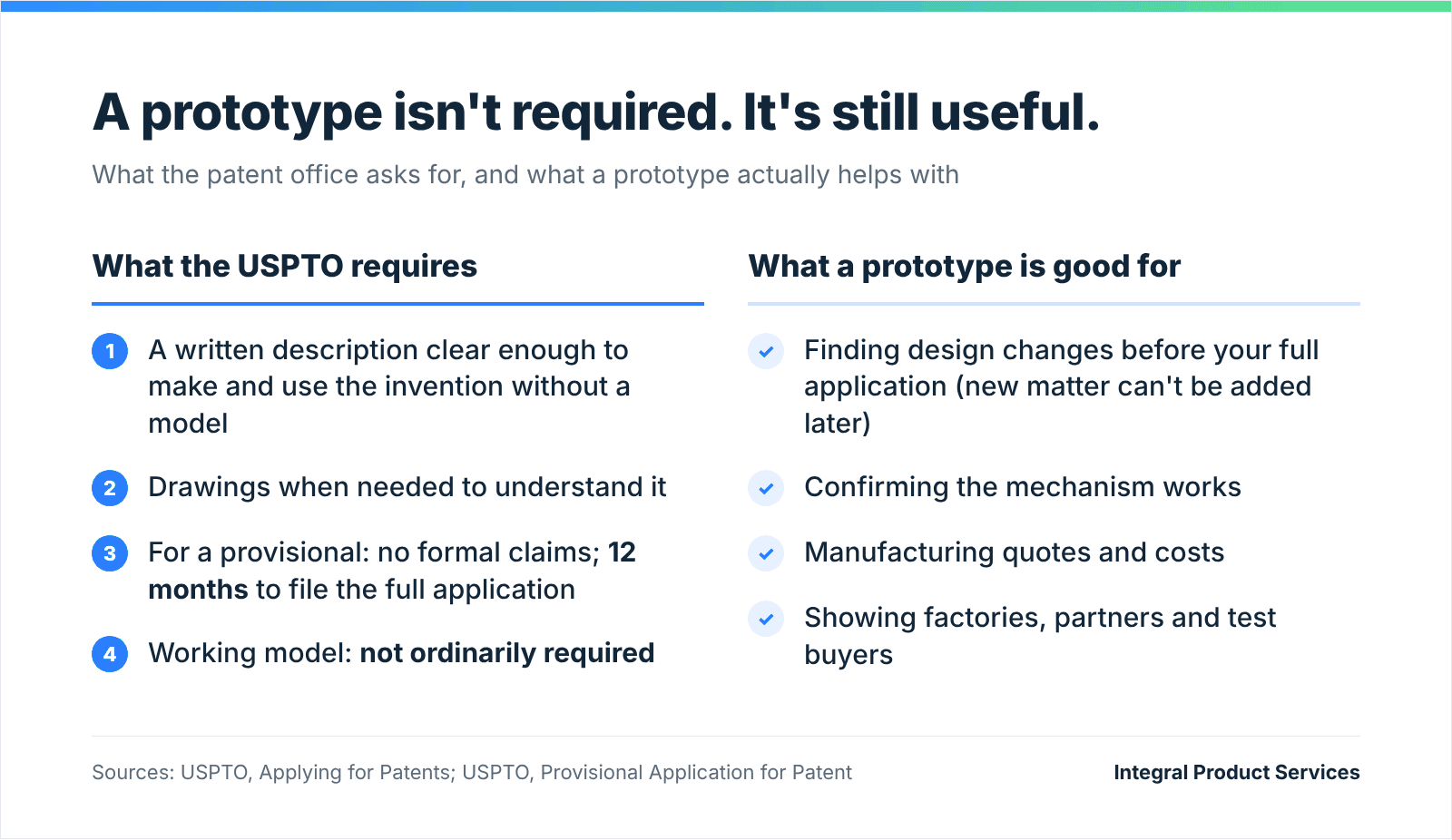
No. On its own guide to applying for patents, the USPTO says a working model or other physical exhibit “is not ordinarily required.” The written description and drawings are expected to be “full, clear, and complete enough to understand the invention without the aid of a model.”
The exceptions are narrow. The USPTO notes that a working model may be requested for alleged perpetual motion devices, and that applicants for some compositions of matter may be asked for specimens. Under its rules (37 CFR 1.91), the office can also require a model if it deems one necessary for examination. For the typical consumer product, that rarely happens.
Free to use with credit: you may share this graphic as long as you link back to this article.
Why can’t you patent “just an idea”?
Because the law protects an invention as you describe it, not the concept behind it. A utility patent application (the most common type) must describe the invention in a way that lets a skilled person in the field make and use it (35 U.S.C. 112(a)).
The USPTO’s own pro bono program puts it plainly: before it can match you with a volunteer attorney, you need “an actual invention, not merely an idea,” which you can describe well enough for someone else to make and use it.
In practice, the difference between an idea and an invention is detail:
- How the parts fit and move together
- What it is made of, and why those materials
- Approximate dimensions, and which ones matter
- The variations that would still work, so a competitor cannot sidestep you with a small change
A prototype is one way to work those details out; careful CAD design is another.
What happens if your design changes after you file?
This is the real risk, and it is why the “prototype first” advice exists. Once an application is filed, you generally cannot add new technical content to it. The USPTO’s page on provisional applications warns that a drawing needed to understand the invention “cannot be introduced into an application after the filing date because of the prohibition against new matter.”
So if building a prototype reveals that your hinge needs a different shape, the original filing still covers the original hinge. The improvement has to go into a later filing, such as a new provisional or the full application itself, and it only gets that later filing date. Filing early protects what you described, not what you discover later. That is the honest limit of “file first”: rushing a rough concept into an expensive application can leave you protecting a product you never make.
And even a strong patent is protection, not proof that anyone will buy, as we explain in what a granted patent does and does not do.
How does a provisional application buy you time?
A provisional application is a lower-cost first filing that holds your place in line. According to the USPTO, it does not need formal patent claims, it is not examined, and it lets you use the term “patent pending.” It lasts 12 months from filing, and that period “cannot be extended.”
To keep the provisional’s filing date, you must file a full nonprovisional application within those 12 months, and what you claim in it must have support in the provisional. That makes the provisional only as useful as the detail you put into it.
Used well, those 12 months are when the prototype earns its keep: testing with real users, getting manufacturing quotes and checking demand, so the full application describes the product you will actually sell. Our article on the provisional patent strategy walks through that year in more detail.
One caution: “patent pending” is a notice, not protection. The USPTO says patent protection does not start until a patent is actually granted, and a provisional application on its own gives you no rights against copiers.
Should you build a prototype before or after you file?
It depends on what you still need to learn:
- Prototype before filing when you are not sure the mechanism works, the materials or key dimensions are still open, or you suspect manufacturing cost could force a redesign.
- File first, then prototype when the design is settled on paper and you need to show it to factories, partners or test customers.
- Either way, keep it confidential until you file. In the US, the inventor’s own public disclosure gets a one-year grace period under 35 U.S.C. 102(b)(1). Many other countries are stricter. The World Intellectual Property Organization notes that some countries allow a grace period, usually 6 to 12 months, and that a prior public disclosure can block a valid patent in countries without one. If you may want protection abroad, file before you show it publicly.
A prototype does not have to be physical at first. Digital prototypes, meaning 3D CAD models and photorealistic renderings, can work out many design details and show potential buyers what the product looks like before you pay for tooling. They have limits: a rendering cannot tell you whether a mechanism holds up, how something feels in the hand, or what it costs to make.
Getting this sequence right takes product design, engineering, patent drafting and market testing, and coordinating them is its own job.
Where can you get help with the patent itself?
If cost is the barrier, the USPTO runs a Patent Pro Bono Program that connects eligible inventors with volunteer patent attorneys through regional programs. Income limits apply and vary by region. The pro bono program is free for those who qualify. The USPTO’s Pro Se Assistance Center also answers questions from inventors who file on their own, though it cannot give legal advice.
Not sure what to build first?
At Integral Product Services, we help inventors with a granted or pending patent turn it into a market test before they spend on tooling: renderings, a simple website and the data to decide what comes next. If you hold a patent or a pending application, you can request a free, no-obligation Patent Review or call us at 813-413-1863.
Not ready for a call? The same page offers our free guide, After You File.
This article is general information, not legal advice. Patent rules and deadlines depend on your situation. Talk to a registered patent attorney or agent before you file or disclose your invention.
Sources
- USPTO, “Applying for Patents”
- USPTO, “Provisional Application for Patent”
- 37 CFR 1.91, “Models or exhibits not generally admitted as part of application or patent” (Legal Information Institute)
- USPTO, “Patent Pro Bono Program: Inventors”
- USPTO, MPEP 2151, Overview of the Changes to 35 U.S.C. 102 and 103 in the AIA
- USPTO, “Pro Se Assistance Center”
- USPTO, “Managing a patent”
- WIPO, “Frequently Asked Questions: Patents”
Have a patent or patent pending? Let’s find your next step.
Get a free Patent Review from a Product Launch Specialist. No cost, no obligation, prototype not required.