
Why Every Invention Needs a Professional Prototype Before a Patent
For many inventors, the journey starts with a sudden “lightbulb moment” and a frantic sketch on the back of a napkin. The excitement is palpable, and the immediate instinct is often to rush to a patent attorney to lock down the idea before someone else steals it.
However, there is a massive gap between a great idea and a marketable product. This is where the professional prototype becomes your most valuable asset.
While it is tempting to skip this step to save money, filing for a patent without a tangible model is often a financial trap. This guide explores why building a working model is the ultimate “stress test” for your invention—and why it is crucial for securing robust, defensible intellectual property protection.
The Hidden Risks of “Paper Patents”
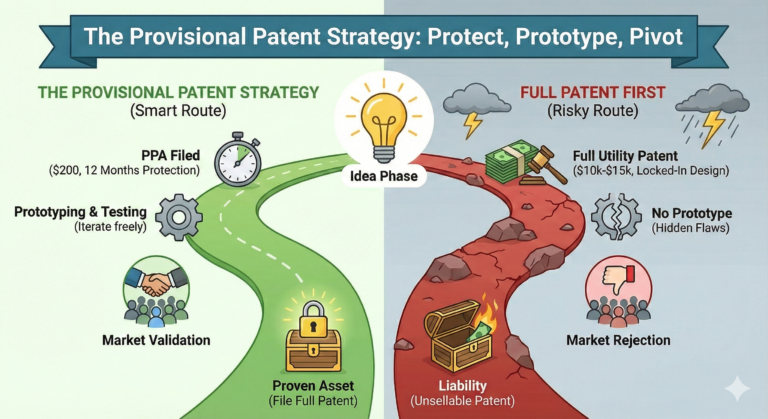
A “paper patent” is one filed based solely on theory and drawings, without ever reducing the invention to practice. While legally permissible, this approach carries significant risk.
If you file a patent application based on a theoretical design, and later discover during manufacturing that the mechanism fails or requires a major design overhaul, your original patent may become worthless. You would then be forced to file a “Continuation-in-Part” (CIP) or an entirely new application to cover the actual working version of the product.
By investing in a professional prototype first, you identify these design flaws before you pay thousands of dollars in legal fees. It is significantly cheaper to modify a 3D-printed model than it is to amend a filed patent application.
How a Professional Prototype Strengthens Your Claims
The United States Patent and Trademark Office (USPTO) requires that an invention be “useful” and “enabled”—meaning you must describe it well enough that someone skilled in the field could replicate it.
A rough sketch often lacks the nuance required for strong patent claims.
When you work with engineers to build a professional prototype, you uncover specific technical details:
-
Precise dimensions and tolerances.
-
Specific material requirements (e.g., why polycarbonate works better than ABS for your specific use case).
-
Unique assembly mechanisms that you hadn’t thought of during the sketching phase.
These details allow your patent attorney to draft broader and more specific claims, making it much harder for competitors to “design around” your patent. Furthermore, a high-fidelity prototype allows you to generate high-quality reference photos and technical CAD drawings, which are essential for a professional patent application.
The Different Stages of Prototyping
Not all prototypes are created equal. Depending on where you are in your development cycle, you may need different types of models before you are ready for a patent or investors.
-
Proof-of-Concept (PoC): This is often a “looks-like-junk” model. It might be made of cardboard, duct tape, or rough 3D prints. Its only job is to prove the physics of your idea work.
-
Works-Like Prototype: This model functions exactly as the final product will, but it may not look pretty. It houses the electronics, gears, and mechanics.
-
Looks-Like Prototype: A non-functional model that demonstrates the aesthetic, ergonomics, and size of the final product.
-
The Professional Prototype (Pre-Production): This is the gold standard. It looks like the final product and works like the final product. This is the version you need for crowdfunding videos, sales meetings, and final patent validation.
Validating Your Invention for Investors
Investors do not invest in ideas; they invest in execution. Walking into a pitch meeting with a slide deck is common; walking in with a sleek, fully functional professional prototype is a game-changer.
A tangible model demonstrates that you have moved beyond the “dreamer” stage and are ready for business. It answers the critical questions that sketches cannot: Does it feel right in the user’s hand? Is it durable? Can it be manufactured at scale?
Turn Your Vision Into Reality with Integral Product Services
Don’t leave your intellectual property to chance—let the engineering guide the legal protection.
At Integral Product Services, we specialize in bridging the gap between a raw concept and a market-ready product. Whether you need a rough proof-of-concept to test the physics or a polished professional prototype ready for a patent attorney, our team has the expertise to bring it to life.