
Is Your Idea Ready for the Market?
5 Questions to Ask Before You Spend a Dime
The “Eureka” Moment is Dangerous
We have all been there. You are driving to work, or maybe standing in the shower, when suddenly—it hits you. The perfect idea. The gadget that fixes that annoying problem everyone has. The “Why didn’t I think of that sooner?” invention.
The rush of adrenaline is real. You start visualizing the patent, the branding, and the units flying off the shelves. You are ready to empty your savings account to get this thing made.
Stop.
At Integral Product Services, we have seen hundreds of inventors walk through our doors. The difference between the ones who succeed and the ones who end up with a garage full of unsold inventory often comes down to one thing: Product Market Validation.
Before you hire a patent attorney or pay for an expensive prototype, you need to stress-test your concept. Here are the five questions you must answer to ensure your idea is truly market-ready.
1. Are You Selling a “Vitamin” or a “Painkiller”?
In the world of product development, ideas generally fall into two categories: vitamins and painkillers.
-
Vitamins are “nice to have.” They improve life slightly, but people can live without them.
-
Painkillers solve an immediate, burning problem. People actively search for them because they need relief.
While you can build a business on a “vitamin,” it is significantly harder to market. The most successful inventions are painkillers. Ask yourself: Does my product solve a problem that keeps people awake at night? Is the frustration level high enough that a stranger would pull out their credit card to make it stop? If the answer is “meh,” you might need to refine your concept to address a sharper pain point.
For a deeper dive into this concept, check out this breakdown on identifying customer pain points from Forbes.
2. Who Else is Doing This? (And Don’t Say “Nobody”)
One of the biggest red flags we hear from new inventors is, “I have no competition. No one has ever done this before.”
Usually, this means one of two things:
-
You haven’t looked hard enough.
-
There is no market for it.
If big companies haven’t tried to solve this problem, there might not be enough profit in solving it. Competition is actually a good thing—it proves there is a paying market.
Your first step should be a rigorous search. Don’t just check Amazon; you need to look at technical history. We highly recommend using the USPTO Patent Public Search tool to see if your “new” idea was actually patented (and abandoned) 20 years ago.
Your goal isn’t to be the only one; it’s to be the better one. You need a Unique Selling Proposition (USP). Maybe your version is cheaper, faster, more durable, or eco-friendly.
3. Can You Make It for $X and Sell It for $4X?
You might have the best idea in the world, but if the math doesn’t work, you don’t have a business; you have a hobby.
Many inventors get to the manufacturing stage only to realize their product costs $50 to make, but customers are only willing to pay $60. That leaves no room for marketing, shipping, retail margins, or your own profit.
The Golden Rule: generally, you want your Cost of Goods Sold (COGS) to be roughly 20% to 25% of your final retail price.
This is where working with a team like Integral Product Services becomes vital. Because we understand sourcing and manufacturing logistics, we can help you estimate these costs before you commit to a factory.
4. Is the Design Actually Manufacturable?
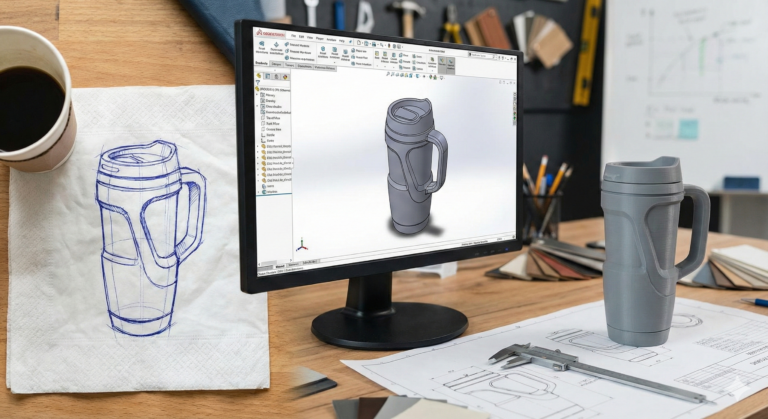
There is a massive canyon between a sketch on a napkin and a CAD file ready for a factory mold. A shape that looks beautiful on paper might be impossible (or astronomically expensive) to injection mold.
This is the concept of Design for Manufacturing (DFM).
If your design requires complex assembly, rare materials, or impossible geometries, your costs will skyrocket. Before you spend money on marketing, you need to know if the product is feasible. This is why we often recommend starting with a “Works-Like” prototype to prove the function, followed by a “Looks-Like” prototype to refine the aesthetics for production.
5. Are You Married to the Solution or the Problem?
Finally, a question about mindset. The market is cruel to rigid inventors. You might discover that your original design is too expensive, or that users find it confusing.
Are you willing to change your baby?
The best entrepreneurs fall in love with the problem, not their specific solution. If you find out that customers want your gadget to be smaller, or blue, or digital rather than analog, you must be willing to pivot. If you are too attached to your original vision to listen to market feedback, your risk of failure increases exponentially.
The “Smart Way” to Launch
Proper product market validation can feel overwhelming, but you don’t have to do it alone.
At Integral Product Services, we don’t just “make things.” We guide you through the entire journey—from validating the concept and engineering the prototype to securing patents and managing global manufacturing. We bridge the gap between a great idea and a profitable business.
Don’t leave your invention to chance.
If you have an idea and want an honest, professional assessment of its market readiness, let’s talk.
Are you sitting on an invention idea because you aren’t sure how to develop it? We help creators navigate the journey from idea to shelf safely every day. Contact Integral Product Services to discuss your project under a signed NDA.