
Patent Myth Busted: Do You Need a Patent Before Prototyping?
It is the single most paralyzing fear for any first-time inventor: “What if someone steals my idea?”
You have a brilliant concept. You can picture it perfectly. But you are terrified to tell anyone—not an engineer, not a designer, and certainly not a manufacturing partner—because you saw The Social Network and you’re convinced your billion-dollar idea will vanish the moment it leaves your lips.
This fear leads to one of the most common, expensive, and progress-killing myths in the industry.
MYTH: You need a full, expensive Utility Patent before you ever talk to a product developer or build a prototype.
TRUTH: If you file a full patent on day one, you are likely wasting thousands of dollars and potentially weakening your eventual protection.
Here is the reality check on the timing of protecting your invention, and why rushing to the patent office before you start prototyping is usually a mistake.
The Problem with Patenting a “Guess”
The United States Patent and Trademark Office (USPTO) does not patent ideas; they patent the execution of ideas. They need specifics. How does it work? What are the exact components? How do they interact?
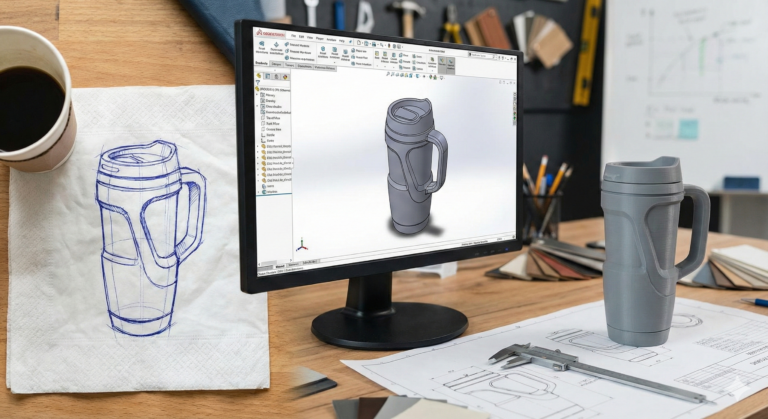
If you are at the “napkin sketch” stage, you don’t know those answers yet. You only have a hypothesis of how it will work.
The journey from a sketch to a retail-ready product involves immense amounts of change. Through engineering and prototyping, you will discover that your initial assumptions were wrong. You will change materials, alter mechanisms to cut manufacturing costs, and redesign features to improve user experience.
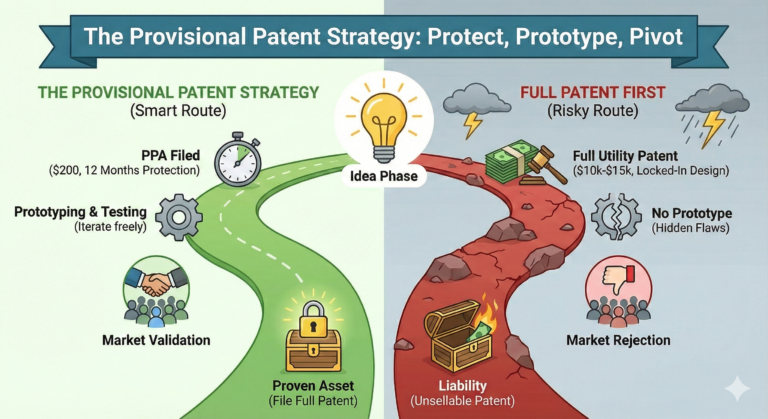
Here is the trap: If you spend $10,000 filing a non-provisional utility patent on your initial sketch, that patent protects that specific sketch.
Six months later, when your final, functional prototype looks and works completely different than the sketch, your expensive patent no longer protects your actual product. You have protected a version of your invention that will never exist, and left the real version exposed.
You have put the cart before the horse. You need to develop the product before you lock down the protection.
The First Line of Defense: The NDA
So, how do you talk to development experts without getting ripped off? You use a Non-Disclosure Agreement (NDA).
An NDA is a legal contract between you and another party (like Integral Product Services or a potential contract manufacturer). It essentially states that you are sharing confidential information for the purpose of evaluating a business relationship, and they are legally bound not to steal it, share it, or use it to compete with you.
Any reputable product development firm or factory will sign an NDA without hesitation. It is standard industry practice. It allows you to safely share your concept so you can get accurate quotes on engineering and prototyping costs.
The Smarter Strategy: The Provisional Patent Application (PPA)
If an NDA doesn’t feel like enough protection, but you aren’t ready for the massive expense and rigidity of a full utility patent, there is a perfect middle ground designed exactly for this phase: The Provisional Patent Application (PPA).
Think of a PPA as an inexpensive “placeholder” with the USPTO. It is not a full patent, and it will never become one on its own. However, filing one gives you two massive advantages:
-
“Patent Pending” Status: You can legally put “Patent Pending” on your prototypes and marketing materials, which acts as a major deterrent to copycats.
-
An Early Priority Date: It locks in your place in line. If you file a full utility patent within 12 months, your protection backdates to the day you filed the PPA.
A PPA is significantly cheaper and requires less formal detail than a full patent. This is crucial. It buys you one full year to engineer your product, build prototypes, test the market, and finalize the design for manufacturing.
Once the design is frozen and you know you have a winner on your hands, then you convert that PPA into a full utility patent, protecting the correct, final version of your invention.
Don’t Let Fear Stall Your Future
Don’t let the fear of theft stop you from making progress. While protecting your IP is vital, obsessing over a full patent too early will drain your budget before you’ve even built a proof-of-concept.
Use NDAs to talk to partners. Use a Provisional Patent to secure your place in line. And spend your energy and budget on what matters most right now: turning that idea into a tangible, testable prototype.
Disclaimer: Integral Product Services is a product development and sourcing firm, not a law firm. The following information is for educational strategies regarding product development and should not be taken as legal advice. Always consult a qualified patent attorney for legal counsel.
Are you sitting on an invention idea because you aren’t sure how to protect it while developing it? We help creators navigate the journey from idea to shelf safely every day. Contact Integral Product Services to discuss your project under a signed NDA.