
Part of our guide Test Before You Build, which puts every article on this topic in the order you will need them.
Key takeaways
- Price a new product by working backward from what each sales channel takes, not forward from what it costs you to make.
- On your own website, payment fees, shipping and the advertising it takes to win each sale can use up more of the price than manufacturing does.
- On Amazon, the referral fee in many categories is 15%, and fulfillment fees rise during the holiday peak, which runs from October 15, 2026, to January 14, 2027.
- Selling through retailers usually means accepting a wholesale price far below retail, so test the price buyers will pay before you commit to inventory.
Most inventors set a price by starting with what the product costs to make and adding a markup that feels fair. The trouble is that the price a shopper pays is not the money you keep. Every channel takes its share first: payment processors, marketplaces, shipping carriers, ad platforms and retailers.
A timely example: Amazon’s holiday peak fulfillment fees took effect on October 15, 2026, and run through January 14, 2027. According to Supply Chain Dive, Amazon said the peak increase averages $0.32 per unit, and a 3.5% fuel and logistics surcharge it began charging in April, which it said would stay in effect until further notice, applies on top. Small per-unit costs like these are easy to miss when you price a product, and they add up on every sale. Here is a simple way to build a price that still works after everyone takes their cut.
Start with your true cost per unit
Your starting number is the landed cost: what it costs to get one finished unit to your door, including manufacturing, packaging, freight, duties and inspection. Many inventors use the factory quote alone and come up short. We explain how to build that number in Landed Cost: The Number Every Licensing Partner and Investor Will Ask For.
If you don’t have quotes yet, use a range rather than a single guess, and price against the high end.
What does each sales channel take?
The same $40 price leaves very different amounts depending on where it sells.
Your own website. On Shopify’s Basic plan in the US, the standard online card rate is 2.9% plus 30 cents per order. That fee is small. The bigger costs are shipping the order to the customer and the advertising it took to win the sale. For a new brand with no audience yet, the ad cost per sale can be the largest single expense, as we covered in Cheap Traffic Is Gone. What Rising Ad Costs Mean for a Brand-New Product.
Amazon. Amazon charges a referral fee on each sale, a percentage of the price that depends on the category. Its seller pricing page lists 15% for Home and Kitchen, with a $0.30 minimum. If Amazon ships for you, add the fulfillment fee and the 3.5% surcharge on it. Supply Chain Dive’s examples include a T-shirt-sized item (large standard size) going from $6.14 to $6.53 during the 2026 peak. Advertising on Amazon is usually a cost too.
Retail stores. A store buys from you at a wholesale price and needs its own margin on top. Many retailers roughly double the wholesale price, a practice called keystone pricing, though your buyer may expect more or less. If your product should sell for $40 in a store, you may be getting about $20.
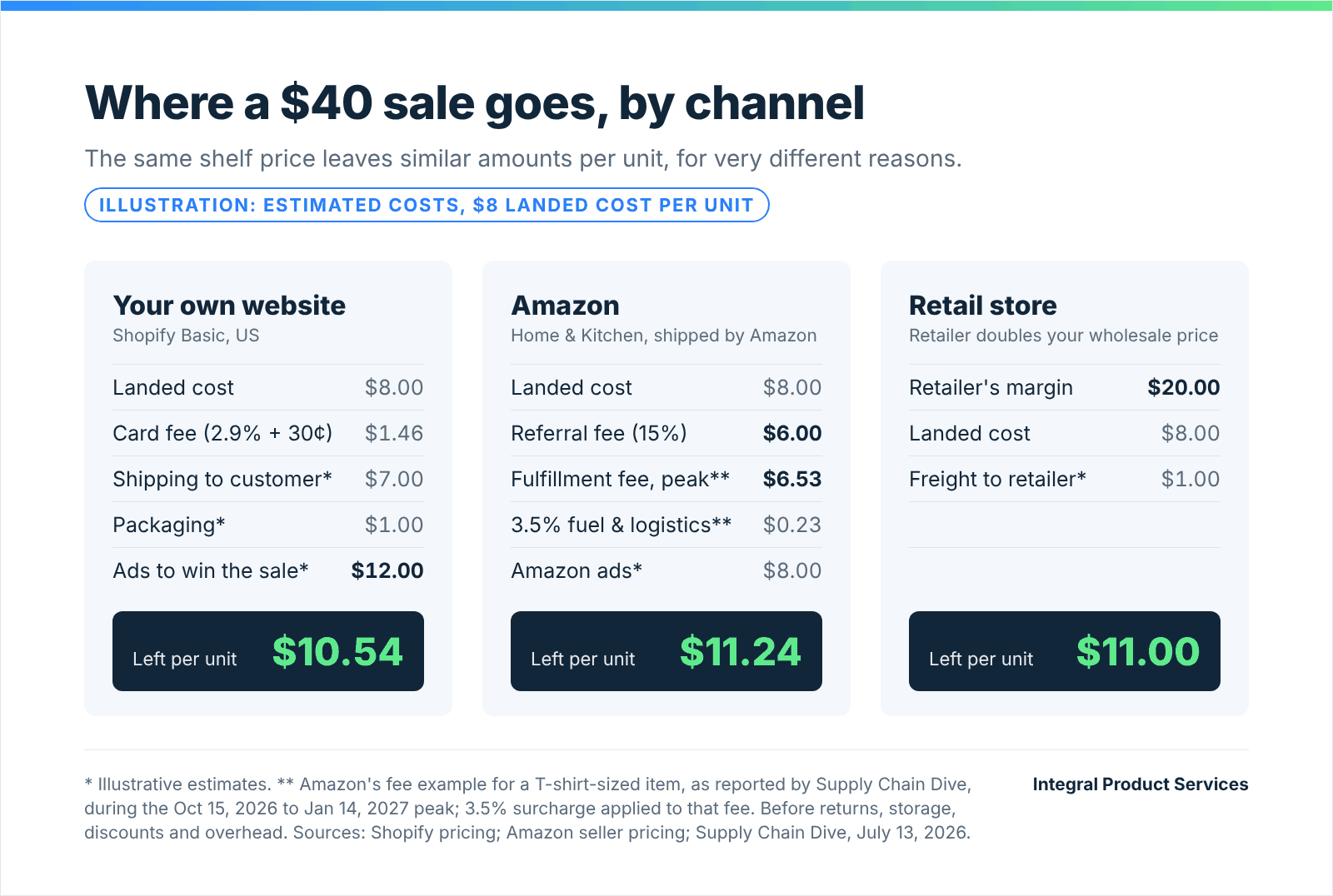
Free to use with credit: you may share this graphic as long as you link back to this article.
The illustration above uses made-up, illustrative costs. Notice that the three channels leave similar amounts per unit, but for different reasons. On your own site, advertising takes the most. On Amazon, fees do. In retail, the store’s margin does. That is why a price that works on one channel can fail on another.
Work backward to your price
Once you know what each channel takes, set the price from the top down:
- Look at what shoppers already pay for the closest alternatives, and decide where yours fits: cheaper, about the same, or worth more because it solves the problem better.
- Subtract each channel’s costs at that price: fees, shipping, ads, and the retailer’s margin if you plan to sell wholesale.
- Check what’s left against your landed cost. You need enough left to cover returns, damaged units, customer service and the price cuts you’ll run at some point.
- Adjust before you commit. If the numbers don’t work, the answer may be a lower-cost design, a different first channel, or a higher price backed by a clearer benefit.
If you plan to license instead of selling it yourself, this math still matters. A company deciding whether to license your product runs its own version of it, and a product that can’t reach a sensible shelf price is a hard sell.
Test the price before you buy inventory
The honest limit of all this math is that it tells you what price you need, not what price people will pay. Those can be very different numbers. Only buyers can answer the second question.
The cleanest way to find out is to put a real price in front of real shoppers before you spend on inventory, for example with a pre-order page or a waitlist that shows the price. We walk through how in Pre-Orders as Market Research: What the Numbers Can and Cannot Tell You. Watch what people do, not just what they say. A click on “pre-order” at $40 tells you more than a survey answer that says $40 sounds fair.
Pricing also connects several specialties: cost estimating, channel fees, ad performance and the data from your test. Pulling those together is a job of its own, and it is worth doing before the first production run rather than after.
Want help pricing your product?
At Integral Product Services, we help inventors test the market before they spend on inventory, with renderings, a website that can take pre-orders and collect emails, social campaigns and the analytics to read the results. If you hold a patent or a pending application, you can request a free, no-obligation Patent Review or call us at 813-413-1863.
Not ready for a call? The same page offers our free guide, After You File.
This article is general information, not financial advice. Platform fees change often. Check each platform’s current fee pages before you set a price.
Sources
- Supply Chain Dive, Max Garland, Amazon announces 2026 holiday fulfillment fees, advises early shipping, July 13, 2026
- Amazon, How much does it cost to sell on Amazon?, accessed October 15, 2026
- Shopify, Pricing, accessed October 15, 2026
Have a patent or patent pending? Let’s find your next step.
Get a free Patent Review from a Product Launch Specialist. No cost, no obligation, prototype not required.